More original music on piano and guitar
3D or Not 3D?
Here’s a playlist of the 3D videos I shot back about a decade ago,
(Note: you’ll need to set your 3D preference in the settings and for best effect, you’d need to play it on a 3D ready monitor with 3D glasses.)
I was always fascinated with 3D. Back in high school, I made my own 3D set up by shooting two slides of such things as the Grand Canyon from six inches apart side by side. Then, I got polarizing material (which was just coming out to the public) from Edmund Scientific Company (such a cool company with all kinds of things like glass fragments fused from the sand by the first atomic explosion in New Mexico – still have some!) Edmund Scientific is now Scientifics Online. Worth checking out. That’s where Teresa got my Christmas gift one year – a cutting of foil from the command module of Apollo 11 that actually flew around the moon on that historic mission – all dressed up in a an expensive glassed in frame about 16 x 20, suitable for wall hanging.
But getting back to the 3D – I took that polarizing material (like most sunglasses today, but just flat plastic) and cut it into four pieces. I made glasses with two of the pieces, with each piece rotated by 90 degrees from the other in the angle of polarization.
Then, I put the other two pieces, oriented the same way, in front of the lenses of two slide projectors.
That way, each eye would only see one image, the other being blocked by the rotated polarizing filter, hence creating 3D. Now I discovered the old glass-bead projection screens like my grandfather had used to show our home movies scattered light, so the polarization was lost.
But the newly released mylar screens maintained the polarization. So, I used one of those. I then adjusted the throw of both projectors so the two images lined up so that objects in the farthest distance lined up as they would in real life, with no parallax. Then, the degree of parallax would create the 3D effect for the brain, just as in normal 3D.
I showed my rinky dink system to family and friends, and they were amazed, since most of them had never seen 3D projections before, and those that had, had only seen the old red and blue glasses 3D that they used on such movies as Creature of the Black Lagoon and House of Wax (with Vincent Price) in the movie theaters in the 50s.
I’ve seen Creature in 3D with Red and Blue when I took Mary to a screening at USC where I was in the film school. Gave me a freaking headache (the movie, not Mary) which is a common problem with that old technique.
Saw House of Wax in a re-release with polarized glasses, which was much better. Later I saw Andy Warhol’s Frankenstein in 3D and in College, my friend Chris Huntley and I went to a porno movie that was in 3D – not to see the porn but because there were hardly any 3D movies in those days and, with us both in film school, we just wanted to study the techniques. Seriously. (Film nerds).
Of course now, most big action movies have a 3D release. And these days, they don’t even shoot in 3D – the just post-process with computers – techno louts! Even the big screen TV I bought almost ten years ago shows 3D and even does 2D to 3D conversions of any program (including home movies) in real time!
Which brings me to the last part of this note. After successfully rigging up a system for 3D slide projection, I tried it with movies. I’d do the same thing – put two movie cameras side by side, shoot the scene. Then set up two projectors with the polarizing filters and run both.
It worked great if it was a still life, but if things were moving around, I needed to be very careful to sync up both projectors so the images were in the right places for 3D, not drifting all over the screen relative to one another. That was tough since in those days there was no practical way, mechanical or electrical, to sync two consumer grade projectors (which is all I could afford in high school).
Still, after a while, I got pretty good at turning them on and off until I hit a mark on each, then starting them together and letting them run in near-sync, which was good enough for my purposes.
But, that was a lot of work for just a few seconds of 3D motion, so I eventually dropped the project, having at least succeeded in proof of concept.
And then, about ten years ago, Fuji came out with the first relatively inexpensive home 3D camera / video camera. I was ecstatic! I scraped together my meager funds, purchased one, and raced out to shoot some sample movies (the ones in this playlist on YouTube). YouTube had just upped their tech to allow for 3D so I bought one of the first home 3D monitors as well for my computer.
End of story – I shot a bunch of these, and they are wonderful, but in the end, after the thrill of finally being able to achieve a flawless 3D effect that I had been chasing since high school, once achieved, the drive was over and I got back to shooting regular flat videos since the 2D to 3D conversion just keeps getting better.
Still, it was SO worth it – like scratching an itch you’ve had for 40 years. Still got all the equipment. Maybe I’ll take another whirl at it, having got myself all interested again in the writing of this.
Enjoy….
Entropy Rusts
The temporal equivalent of dust
softens meaning and levels souls
Here and Gone
O blob of rock,
my home, my grave,
hill of king,
dale of knave,
flog of master,
song of slave,
eons take ye all.
Seriously?
Facebook sent me a message:
“Learn about how you can make small changes in your daily life to have a positive impact on the planet.”
Why bother when there are people out there making big changes that have a negative impact?
Tick Tock
67 and still waiting for something to happen. Don’t know what it is. Hope I’m here when it finally arrives
The Burbank Block
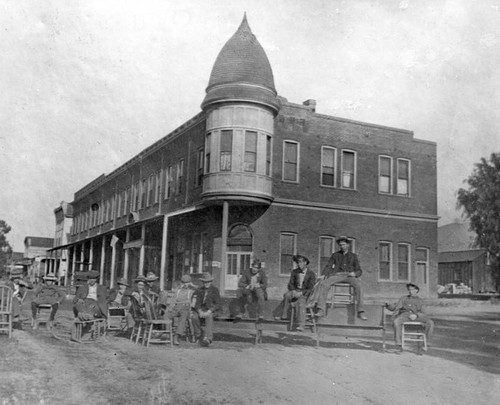
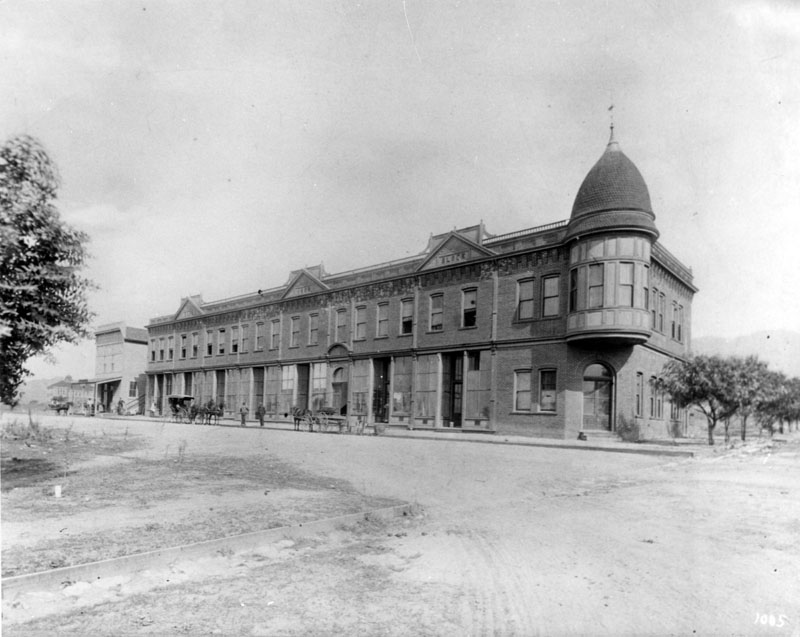
In the 1980s I had my first office in the first brick building in Burbank, built at San Fernando Road and Olive in 1888, pictured here. In fact, I was there for the building’s centennial (which no one celebrated because no one know about it then).
By the time I was installed, it had changed quite a bit. The parapet was gone in an earthquake many decades ago, and the bottom part was now a series of independent businesses, food establishments and the sort.
The upper offices were really cool. Heavy oak doors with transoms and patterned plate glass in them. Much like the feel of a seedy private detective in the 1940s or a railroad office in the old west.
I had found the office because my college friends from film school, Chris Huntley and Stephen M Greenfield had set up their new company there, Screenplay Systems, where they developed and marketed the world’s first screenplay formatting software called Scriptor (for which they both later won a Technical Achievement Award from the Academy (you know, the Oscars).
I recall driving by the building several times on my way home from an editing job in Hollywood and seeing the light on in their office, with Steve visible in the window, cranking out the code for Scriptor on the Z-80 computer he had built himself from a Heathkit.
Steve had previously been the director of photography on the first feature length film I directed called The Strangeness, which you can see even today on Amazon Prime – though none of us get any residuals from it.
Chris was my co-producer and co-writer (along with Mark Sawicki, the first friend I made at USC). Chris, Steve, and Mark were roommates at the time we made The Strangeness, I believe, though I don’t remember if Chris had moved out yet.
I do know that we shot a few of the special effects shots for The Strangeness there at the house in Burbank they were renting together.
One shot was designed to look like a horizontal mine tunnel and a huge ball of fire was supposed to rush down it toward our heroes. Mark and Chris did this by creating a miniature of the tunnel about 2 x 2 feet and ten feet long, and placed it vertically.
At the bottom, they placed a film can filled with hot melted paraffin, then lit the fumes above it on fire, like a flambe. Mark had a camera secured at the top behind a sheet of plexiglass. He’d climb up a ladder, start the camera to shoot extra fast to create slow motion when played at normal speed.
As soon as the camera started, Chris would throw a glass of water on the flaming paraffin and it would explode in a fireball when the steam vaporized and would shoot twenty feet into the air, right past the camera.
We did several takes, at night of course (for best effect) and late so no one would be watching, since we were pretty sure it was illegal. Sure enough, after every explosion, we’d hear the beating of a police helicopter which would fly nearby looking for whoever was creating these fireballs.
But the flash only lasted a couple seconds so we’d just freeze in place with the lights off until it flew away and then set off the next one. Two minutes later they’d be back again, and we played cat and mouse like this for about an hour until we got all the shots we needed. Fortunately, they never got a fix on us.
The shot turned out great in the movie, by the way, though if you look closely you can see the “rock” walls shudder a bit because they were actually made of industrial thickness aluminum fail, crinkled to look like rock, then spray painted appropriately with dirt thrown on the wet paint to complete the look.
Another effects shot we did there was of a second miniature tunnel where we did stop motion photography of our tentacled monster in the mine.
All the tentacles had to be slightly moved and then one frame shot then moved again, then another frame, and so on. At 24 frames per second, it not only took a lot of time, it was also very complex to keep each of the many tentacles twisting and curling in the right directions. And on top of this, Mark added an animated camera movement down the tunnel during the stop-motion by repositioning the camera slightly after each adjustment to the miniature monster!
I even animated one of the monster shots myself just for the fun of it.
Anyway, Mark and I were the only crew on this, though I think a shot or two was done by Mark’s semi-famous animator friend, Ernie Farino at another time.
This day, we needed to create some fog on the miniature set, but couldn’t use a fog machine because the animation would make the swirls of fog jumpy and ruin the effect.
After much discussion, Mark remembered he had an orange rescue flare from his uncle’s boat. So, just before we started animating, he set it off in the closed garage where we had our miniature.
In short order, the place was filled with an acrid, lung-burning, orange smoke, but it did create the effect we were looking for – a nice even fog.
So, for an hour or thereabouts we hung out in that space, shooting animation frame by frame, then darting out the side door for a quick breath of fresh air before diving in once again.
In the end, we got the shot and it was really good! But, when I got home, I discovered my white underwear had turned orange. Mark told me later that week he had sneezed up orange snot for three days.
I wondered what that might do to my health. Now, forty year later, so far so good. But, to quote John Milius (director of the original Conan The Barbarian film), “Pain in temporary; film is forever.”
That’s a pretty good place to end this memory thread. Later, I’ll start from that same office building and tell you tales of creating my first album of original music there, bringing my kids there after school so I could continue working while I watched them (and the adventures we had), the true to life Mystery of Geppetto The Mole, and many more stories from the building officially known (when it was built) as The Burbank Block.
“Until next time, this is Gary Owens and Morgul, the Friendly Drelb.”
(Google it)
One of these things is like all the others
We’re all alike
in that we’re all different.
Fix the problem, not the symptom
I think it will bring a lot more of us together if we focus on fixing what’s wrong with the political system than what people are doing wrong within the system.
Honestly, if the system is the problem, you’ll never fix it by attacking the individuals.
102 Year Old Alice Barker in the Soundies
Stumbled on this while watching videos of popular old songs. A truly amazing experience to watch this.
There’s also a web site about this woman, created by the folks who made this video. You can read all about her story and the old “Soundies” (music “videos” of the 1940s that played on film jukeboxes). Back in the 1980s, I owned a videotape duplication company. On client sent in a whole collection of these Soundies – hundreds of them – and wanted me to make a protection copy of them. Since they are public domain, I made two copies – one for him and one for myself, and still have them, tucked away in a box somewhere. Hope I find them soon – I’d really like to view them again, and will share them if and when they turn up.