|
|
Software |
StoryWeaver
$29.95

A step by
step approach to story development, from concept to completed story for
your novel or screenplay. More than 200 interactive Story Cards guide
you through the entire process.
Details
and Demo
Dramatica
$149.95

The most
powerful story structuring software available, Dramatica is driven by a
patented "Story Engine" that cross-references your dramatic
choices to ensure a perfect structure.
Details
and Demo
Movie
Magic Screenwriter
$149.95

The most
advanced screenwriting software available, Movie Magic is deemed a
"preferred file format" by the Writer's Guild. An industry
standard, MMS is used by professionals and studios around the world.
Details
and Demo
Throughline
Index Cards
$9.95
Interactive
index cards - Name them, add notes, titles, colors, click and drag to
re-arrange, adjust font, save, export and print. An essential tool for
every writer.
Details
Academic
Discounts
on Select Products

Are you a
student, teacher, or academic staffer? Get the very best price on select
products with these manufacturer sponsored academic discounts!
Details

|
| |
Relative Associations
of the 8 Archetypal Signs of the I Ching
with the 8 Archetypal Characters of Dramatica
by Anthony
Noa
 |
 |
| If you will notice each of
the trigrams below that are side-by-side , omitting the primary trigrams - Creative and
Receptive, are diametrically opposed to each other, but are also complementary by the
position of their ruling line (the one line that is different from the other two). The
position of the ruling line is in the same place, either top, middle or bottom. Each of
the three places represent man's relationship to his world: yielding-dark-earth (bottom),
the mores of man - love and rectitude (middle), and strong-light-heaven (top). That they
complement and oppose each other demonstrate their complex interrelationship. This suits
well the purposes of Dramatica's theory on the development of complex characters and the
Story Mind. |
| Protagonist
/ Creative |
Antagonist
/ Receptive |
 |
 |
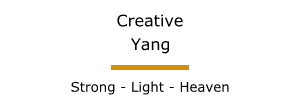
| Strong: Heaven Pro-active; initiates movement, is source of the beginning and end in all
things
Among men it means the prince, the leader, the one who stands in
the center of the field of action |
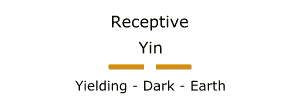
Yielding; Earth Re-active; counters movement, demanding worship in all things
Among men it means the many, the multitude without conscience, the
one who stands below the field of action. |
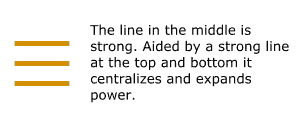
| The ruling lines are not
as apparent because all the lines are the same in each trigram. Since the I Ching's
intentions are directed towards man, then the middle place is is the central and ruler of
the trigram. This pair of trigrams are even more complex than the others. Not only do
their ruling positions and lines oppose and compliment, but through the combination of
their archetypal lines they give rise to the other six trigrams. In essence, each of the
other six trigrams has in its nature the core of heaven and earth (protagonist and
antagonist), and given the right situation (as in I Ching's elemental situations) they can
move one way or the other, depending on what is influencing them. |
| Guardian /
Gentle |
Contagonist
/ Arousing |
 |
 |
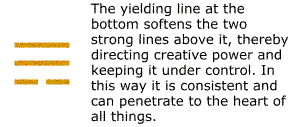
| Penetrating; Wind/Wood All things are brought to completion in this sign; guidance towards
perfection and purity; morality.
Among men it means the gray-haired, or those with broad foreheads
(wisdom). |
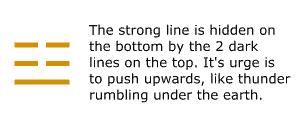
Inciting Movement; Thunder Initiates sub-conscious stirrings, propagator of the unknown; causes
questionable events
Among men it means vehemence; disruptive by nature it causes
things to pause and take notice. |
| These two trigrams
represent the first meeting of the Creative and Receptive (Heaven and Earth), and you
could look at them as representing Adam and Eve in the Christian religion. In the Arousing
you have the Father going to the Mother to beget its first son. In the Gentle you have the
Mother going to the Father to beget the first daughter. Since these are the first children
of the Creative and Receptive their ruling lines are on the bottom. In contrast to each
other, Heaven is above in one and below in the other. Thunder and wind are powerful when paired. They are one of the few
creative-active forces, rather than passive, that resembles the power of the Creative and
the Receptive. When paired they bring either the elemental situation Increase (Gentle
on top of Arousing), or Duration (Arousing on top of Gentle).
It is interesting to note that pairing the Guardian
Archetype to the Gentle you could say the ruling trigram (which is on top) can point to
the elemental situation Increase, which suits the basic nature
of the Guardian. "Wind and Thunder; the image of INCREASE. Thus the superior man:
if he sees good, he imitates it; If he sees faults, he rids himself of them." This
definitely points to the action man takes in regards to morality - a great description of
the archetypal character, Guardian.
Using this same example for the Contagonist the elemental
situation of Duration on its dark side is stated thus - "Restlessness as
an enduring condition brings misfortune... when one loses his inner consistency or
character his actions interfere with good influences..." This is a good
description the Contagonist's archetypal character of placing obstacles in the way of
"good influences". |
| Sidekick /
Clinging |
Skeptic /
Abysmal |
 |
 |
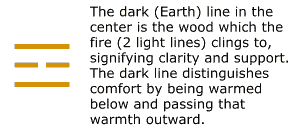
| Clarity; Light-giving; Fire Causes all creatures to perceive one another - assist and support one
another
Among men it means the big-bellied (comfort), and provides
protection |
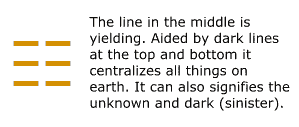
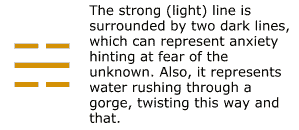
Dangerous; Water Danger precedes doubt and uncertainty, and water is always twisting and
turning;
Among men it means the melancholy, those with "sick"
hearts. |
| These two trigrams are the
second time the Creative and the Receptive meet to beget children. Each of their ruling
lines are in the same place, that of man - or more specifically, the two attributes that
make man part of the earth and the divine, Love and Rectitude. Also, as each ruling line
is central in the trigram structure, it connotes that they receive action as opposed to
initiating action. This is usually a passive state, though not always. Sometimes, because
of strong influences when combined with other trigrams, action must be taken in the face
of not wanting to. This suggest the passive (passenger) roles that are part of the
Sidekick's and Skeptic's archetypal nature described in Dramatica. Using the same example as we did in Guardian/Gentle and
Contagonist/Arousing we have the ruling trigram Cling on top of Abysmal to use as
reference for the Sidekick. This is Before Completion. It is stated thus: "Before
completion friends foregather in an atmosphere of mutual trust...", and... "...
the strong line in 4th place represents the strong official who assists the gentle ruler
(who is the weak line in the 5th place), and therefore helps him carry out his will".
BEFORE COMPLETION definitely suggest the nature of the archetypal role of the
Sidekick.
In contrast the ruling trigram of the Abysmal over the
Clinging gives us its opposite After Completion. It is stated: "...Water
over Fire: the image of the condition in AFTER COMPLETION. Thus the superior man takes
thought of misfortune and arms himself against it in advance." This statement
suggest that one doubts the future and expects trouble. This clearly indicates the nature
of the archetypal character of the Skeptic. |
| Emotion /
Joyous |
Reason /
Keeping Still |
 |
 |
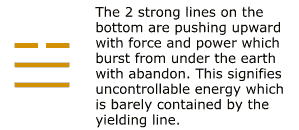
| Joyous; Lake It is where all things come to abundance causing wild abandon; a lake can
be calm and turbulent
Among men it means mouth and tongue - smashing and breaking,
dropping off and bursting open. |
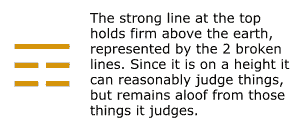
Resting; Mountain It is where the beginnings and endings of all things are known; it is calm
and solid like a mountain
Among men it means the watchful - the fingers which hold things in
its grasp. |
| This pair of trigrams
represent the last time the Creative and Receptive meet, and usually stands for
completion. (Note: the elemental situations of the trigrams Abysmal and Clinging mentioned
above relates to what goes on after and before completion as opposed to completion). The
ruling lines of these trigrams stand at the top and represent outcomes or what is leaving
a situation. Once again, this points to a passive nature. Like the Abysmal and the
Clinging, certain coupling of trigrams will produce forced action, their nature is to be
passive. This points again to the passive (passenger) roles they play in the archetypal
character Dramatica describes. Each ruling line
stands in the place of Heaven and, as signs of completion, each have their particular way
of expressing it. The Joyous represents outward releasing effects of bottled up energy
(strong lines bursting upwards through the earth); Keeping Still represents a calm inward
assimilation of all that it perceives (strong line above it all like a mountain stands on
the earth). Notice that each trigram's lines are in opposition to the places the other
trigrams lines hold, but are complementing each other through the ruling line -- each are
at the top. Simplicity and complexity are at the heart of the I Ching's archetypal signs.
Once again we will examine the coupling of the trigrams
beginning with the Joyous as the ruling trigram and above Keeping still, and is used to
express Emotion. This coupling gives us INFLUENCE / WOOING. I have to believe
that this is not a coincidence. This elemental situation represents courtship and
marriage, the foundations of all relationships. It is stated thus: "If one is
agitated in mind his thoughts go hither and thither...", and... "...
here the place of the heart is reached... influence over others should not express itself
as a conscious and willed effort to manipulate... through practicing such conscious
incitement, one becomes wrought up and is exhausted by the eternal stress and
strain..." This can easily represent Dramatica's archetypal character Emotion.
In contrast, with Keeping Still over Joyous, we have DECREASE.
The coupling gives us this judgment: "...The Image: At the foot of the
mountain, the lake: The image of DECREASE. Thus the superior man controls his anger and
restrains his instincts..." Once again this coupling definitely reinforces the
idea behind Dramatica's archetypal nature of Reason. |
Visit
the Dramatica Theory Home Page
Try Dramatica & StoryWeaver Risk
Free*

$179.95
$29.95
*Try either or both for 90 days. Not working for you?
Return for a full refund of your purchase price!
About Dramatica and
StoryWeaver
Hi, I'm Melanie Anne Phillips,
creator of StoryWeaver,
co-creator of Dramatica
and owner of Storymind.com. If you have a moment, I'd like to tell you
about these two story development tools - what each is designed to do, how
each works alone on a different part of story development and how they can be
used together to cover the entire process from concept to completion of your
novel or screenplay.
What They Do
Dramatica is a tool to help you
build a perfect story structure. StoryWeaver is a tool to help you build
your story's world. Dramatica focuses on the underlying logic of your
story, making sure there are no holes or inconsistencies. StoryWeaver
focuses on the creative process, boosting your inspiration and guiding it to add
depth, detail and passion to your story.
How They Do It
Dramatica has the world's only
patented interactive Story Engine™ which cross-references your answers to
questions about your dramatic intent, then finds any weaknesses in your
structure and even suggests the best ways to strengthen them.
StoryWeaver uses a revolutionary new
creative format as you follow more than 200 Story Cards™ step by step through
the story development process. You'll design the people who'll inhabit
your story's world, what happens to them, and what it all means.
How They Work
Together
By itself Dramatic appeals to
structural writers who like to work out all the details of their stories
logically before they write a word. By itself, StoryWeaver appeals to
intuitive writers who like to follow their Muse and develop their stories as
they go.
But, the finished work of a
structural writer can often lack passion, which is where StoryWeaver can help.
And the finished work of an intuitive writer can often lack direction, which is
where Dramatica can help.
So, while each kind of writer will
find one program or the other the most initially appealing, both kinds of
writers can benefit from both programs.
Try Both Programs
Risk Free!
We have a 90
Day Return Policy here at Storymind. Try either or both of these
products and if you aren't completely satisfied we'll cheerfully refund your
purchase price.
Our
Complete Catalog of Products
|

Get
the Writer's Survival Kit Bonus Package
FREE with ANY purchase!
A $300 Value!
|
|
StoryWeaver
- $29.95
Our
Bestseller! A
step by step approach to story development, from concept to completed
story for your novel or screenplay. More than 200 interactive
Story Cards guide you through the entire process.
|
|
Dramatica
Pro - $179.95
Includes
2 Exclusive Bonuses! The
most powerful story structuring software available, Dramatica is driven
by a patented "Story Engine" that cross-references your
dramatic choices to ensure a perfect structure.
|
 |
Dramatica
Writer's DreamKit - $49.95
Little
brother to Dramatica Pro, Writer's DreamKit is built around the same
patented Story Engine - it just tracks fewer story points. So, you
develop the same solid story structure, just with fewer details.
Perfect for beginning writers or those new to Dramatica.
|
 |
Power
Structure - $149.95
An
all-in-one writing environment with built-in word processor that helps
you organize and cross-reference your story development materials.
INCLUDES DVD SET BONUS!
|
|

|
Power
Writer - $99.95
The little
brother of Power Structure includes the essential organization and word
processing tools writers need the most.
|
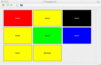 |
Throughline
- Index Cards (Mac) - $19.95
Interactive
index cards - add notes, titles, colors, click and drag to re-arrange.
An essential tool for every writer.
|
|
Movie
Magic Screenwriter - $149.95
The most
advanced screenwriting software available, Movie Magic is deemed a
"preferred file format" by the Writer's Guild. An
industry standard, MMS is used by professionals and studios around the
world.
|
|

|
Final
Draft - $199.95
Like Movie
Magic Screenwriter, Final Draft is an industry standard, used by many
professional screenwriters and studios around the world.
|
 |
Between
The Lines (Macintosh) - $29.95
The lowest
cost automatic screenplay formatter for Macintosh includes high-end
features such as interactive index cards linked to your script.
|
|

|
 |
12
Hour Writing Course - $19.95
Everything
you need to know about story structure - twelve hours of video on a
single DVD - presented by Dramatica Theory co-creator, Melanie Anne
Phillips.
|
 |
Dramatica
Software Companion - $19.95
More than
four hours of video demonstrations of every key feature in Dramatica,
narrated by the co-creator of Dramatica.
|
 |
StoryWeaving
Tips Book - $19.95
170 pages of
eye-opening essays on story structure, storytelling, finding inspiration
and a wide variety of writing techniques.
|
|
StoryWeaving
Seminar 8 DVD Set - $99.95
14 hours of
video from a live two day course taught by theory co-creator Melanie
Anne Phillips covering Dramatica story structure and StoryWeaver
storytelling.
|
|
StoryWeaving
Seminar Online - $49.95
The same 14
hour program presented in streaming video that you can view online or
download for a permanent copy.
|
|
Dramatica
Theory 2 Hour Audio Program - $19.95
Every key
concept in the Dramatica Theory of Story is fully explained in this
double-CD set.
|
|

|
Writing
Characters of the Opposite Sex - $29.95
A three-hour
audio CD set that explains everything you need to know to create
characters of both sexes that ring absolutely true (and maybe even gain
insight into the communication problems in the real world!)
|
 |
Master
Storyteller Improves Your Writing - $29.95
Become a
better writing with this series of interactive exercises.
|
|

|
How
to Create Great Characters DVD - $19.95
A 90 minute
video program recorded during Dramatica co-creator Melanie Anne
Phillips' live in-person seminar on story structure and storytelling.
|
|

|
Structure
vs. Passion - Audio CD $19.95
The Story
Mind approach to writing uses your own passions to create your story's
structure. It focuses your efforts, clarifies the direction of
your story, and triggers your imagination.
|
|

|
Writing
with the Story Mind - Audio CD - $19.95
Learn how to
psychoanalyze your story's "mind" to uncover and treat
problems with characters, plot, theme, and genre.
|
|

|
|
|
Academic
Prices - Discounts on Select Products
Are you a
student, teacher, or academic staffer? Get the very best price on
select products with these manufacturer sponsored academic discounts!
|
|

|
Package
Deals - Starting at $49.95
Get deep
discounts with these bundles of our most popular writing products.
|
|

|
Writer's
Survival Kit Bonus Package - FREE!
Free with
ANY purchase - Writing software, online writing workshops, writing
seminars on video, story theory book, and much, MUCH more!
|
| |
|












 Format:
Windows / Mac CD-ROM
Format:
Windows / Mac CD-ROM
