|
|
Software |
StoryWeaver
$29.95

A step by
step approach to story development, from concept to completed story for
your novel or screenplay. More than 200 interactive Story Cards guide
you through the entire process.
Details
and Demo
Dramatica
$149.95

The most
powerful story structuring software available, Dramatica is driven by a
patented "Story Engine" that cross-references your dramatic
choices to ensure a perfect structure.
Details
and Demo
Movie
Magic Screenwriter
$149.95

The most
advanced screenwriting software available, Movie Magic is deemed a
"preferred file format" by the Writer's Guild. An industry
standard, MMS is used by professionals and studios around the world.
Details
and Demo
Throughline
Index Cards
$9.95
Interactive
index cards - Name them, add notes, titles, colors, click and drag to
re-arrange, adjust font, save, export and print. An essential tool for
every writer.
Details
Academic
Discounts
on Select Products

Are you a
student, teacher, or academic staffer? Get the very best price on select
products with these manufacturer sponsored academic discounts!
Details

|
| |
Chapter 19
The Elements of Structure
Genre
Previously, we have seen that the characteristics which build the Objective Characters
reside at the Element level of the Thematic Structure. Theme itself emanates most strongly
from the Variation level. Plot is generated in the Types. It should not be a surprise,
therefore, to find that Genre is most influenced at the Class level. In fact, matching a
point of view to a Class creates a story's Domains, and it is these Domains that have the
greatest structural impact on Genre.
As one moves up the Dramatica structure, looking from Character to Theme to Plot, the
structural components (the Elements, Variations, and Types) take on a decreasing
significance to the finished work compared to the storytelling aspects involved. Objective
Characters are very easy to define solely in terms of their Elemental dramatic functions.
Theme is a bit less tied to the structure as it explores the comparison between two
dramatic Variations whose balance must be established by the author in the process of
storytelling. Plot can be looked at rather precisely in terms of Acts, but is less so when
it comes to thematic Sequences. At the Scene resolution of Plot a large part of what goes
on is storytelling. At Event resolution, determining exactly what events ought to occur is
almost exclusively storytelling, with the events falling into four broad structural
categories.
Following this progression it stands to reason that Genre, which centers on the Class
level just above where Plot is found, would be the least structural of story aspects and
also the most influenced by storytelling. And so it is.
In a casual sampling of traditional Genres, we immediately notice that Genre sometimes
refers to the setting of a story, as in Westerns or Science Fiction. Other
times, it describes the relationships between characters such as Love Stories and Buddy
Pictures. Genre might pertain to the feeling an audience gets from a story as in Comedy
and Horror Stories. Even styles of storytelling can have their own Genres like Musicals
or Character Studies.
With all these different duties performed by the word Genre, how can we hope to define
it? An attempt is made by video rental stores. All the old standards are there dividing
the movies on their shelves: Action, Drama, Children's. This is fine for picking
out what you want to watch some evening, but not much help to authors trying to create
stories of their own.
Producer: "Write me a war story!"
Writer: "O.K. What do you want, something like M.A.S.H. or Platoon
or The Great Escape?"
Traditional Genre categories are really only useful for grouping finished works. The
overall feel of a story is created from a blending of many different components that have
an impact on the audience. These range from the underlying dramatic structure (storyform)
through the subject matter (encoding) and style (weaving) to audience expectations
(reception).
The traditional concept of Genre is most useful to writers by keeping them mindful of the
"flavor" of their story, no matter if they are working on character, plot, or
theme. Genre would be a lot more useful if it could be clearly defined. This is where
Dramatica can help.
Dramatica intends to help writers construct the deep structure which underlies their
stories. This framework functions as the dramatic skeleton upon which the specifics of a
story are built. Story encoding then places muscle on the skeleton, Story weaving clothes
the creation, and Reception affects how the audience might react to such a thing.
When considering Genre from an author's point of view -- rather than the traditional
audience point of view -- the most critical aspect will be structural. That is where the
foundation is laid, upon which the storytelling will be built. The first step of seeing
Genre this way is to look at the four Classes. These four Classes indicate the nature of
the subject matter that will be covered in a story's Genre. To recap, the four Classes
are:
- Universe 計; an external state; commonly seen as a situation.
- Physics 計; an external process; commonly seen as an activity.
- Mind 計; an internal state; commonly seen as a fixed attitude or bias.
- Psychology 計; an internal process; commonly seen as a manner of thinking or
manipulation.
Modes of Expression
Next, we want to consider a new concept: four modes of expression through which the
story's structure can be conveyed to an audience. The four modes of expression are:
- Information 計; focusing the audience on knowledge.
- Drama 計; focusing the audience on thought.
- Comedy 計; focusing the audience on ability.
- Entertainment 計; focusing the audience on desire.
The Dramatica Classes describe what the audience will see. The modes describe in what
light they will see them. When we match the two categories, we begin to control the feel
our story will generate within the audience.
This is analogous to the manner in which Domains are created by attaching a point of view
to a Class. Domains are part of the Story Mind itself and represent how a mind shifts its
perspective to consider all sides of an issue. Genres, while also creating perspectives,
do so outside of the Story Mind and represent the four different ways an audience can look
at the Story Mind as a finished work they are receiving.
The following "Grid of Dramatica Genres," shows the four Dramatica Classes along
one axis, and the four modes of expression along the other.
Grid of Dramatica Genres
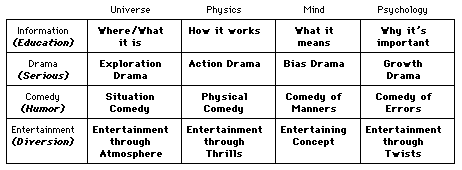
- Where/What it is 計; (Information/Universe) 計; an examination of events and
situations with an emphasis on the past, present, progress, and future "state of
things" (e.g. Documentary, Historical and Period Pieces).
- How it works 計; (Information/Physics) 計; an examination of how specific
processes work with an emphasis on instruction (e.g. Educational, Informational,
Instructional).
- What it means 計; (Information/Mind) 計; an examination of opinions and points
of view with an emphasis on the context in which they are made (e.g. Inspirational,
Motivational).
- Why it's important 計; (Information/Psychology) 計; an examination of value
systems with an emphasis on providing context relevant to the audience's personal life
(e.g. Persuasion, Propaganda).
- Exploration Drama 計; (Drama/Universe) 計; a serious exploration of how the
"state of things" is unbalanced (e.g. Courtroom, Crime, and Classroom dramas).
- Action Drama 計; (Drama/Physics) 計; a serious take on how problems are created
by ongoing activities (e.g. Espionage and War dramas).
- Bias Drama 計; (Drama/Mind) 計; a serious take on what types of conflicts arise
from incompatible attitudes (e.g. Obsession and Prejudice dramas).
- Growth Drama 計; (Drama/Psychology) 計; a serious take on the attempts to
overcome difficulties resulting from manipulations and/or evolving identities (e.g. Coming
of Age and Dysfunctional Family dramas).
- Situation Comedy 計; (Comedy/Universe) 計; humor derived from the difficulties
created by placing characters in some sort of predicament (e.g. TV Sitcoms).
- Physical Comedy 計; (Comedy/Physics) 計; pratfalls, slapstick, and other forms
of humor derived from physical activities gone awry (e.g. The Three Stooges and much of
Charlie Chaplin's work)
- Comedy of Manners 計; (Comedy/Mind) 計; humor derived from divergent attitudes,
biases, or fixations - frequently noted as drawing room comedies (e.g. Jack Benny or Oscar
Wilde's The Importance of Being Ernest).
- Comedy of Errors 計; (Comedy/Psychology) 計; humor derived from
misinterpretation or, in psychological terms, attribution error (e.g. Abbott and
Costello's Who's on First and several Shakespeare comedies including Twelfth
Night).
- Entertainment through Atmosphere 計; (Entertainment/Universe) 計; entertainment
derived from new, unique, or interesting settings or backgrounds (e.g. Disaster, Fantasy,
Horror, Musical, and Science Fiction)
- Entertainment through Thrills 計; (Entertainment/Physics) 計; entertainment
derived from new, unique, or interesting activities/experiences - much like thrill rides
at an amusement park (e.g. Action Adventure, Suspense)
- Entertaining Concept 計; (Entertainment/Mind) 計; entertainment derived from
new, unique, or interesting ideas (e.g. High Concept piece)
- Entertainment through Twists 計; (Entertainment/Psychology) 計; entertainment
derived from new, unique, or interesting forms of audience manipulation (e.g. Mysteries,
Thrillers)
This grid illustrates how the mode of expression can change the impact a Class will have
on an audience. If the Physics Class is expressed in terms of Information it would seem
like a "How to" story. If Comedy is chosen as the mode of expression, however,
the Physics Class looks more like a story involving physical humor or
"slapstick."
The beauty of the grid is that it provides authors with a "shopping list" of the
kinds of impact they may wish to have upon their audience. Take time to fully examine the
table. Look at the brief explanation of each mode/Class combination. Unlike most of the
previous information in this book, this table lends itself to an intuitive feel that ties
in much more closely with the Art of Storytelling than with the Elements of Structure.
Taken together, Classes and modes of expression determine the feel of the subject matter
in a story. Still, there is one aspect of Genre remaining: positioning the audience in
relationship to the subject matter. To do this, we can make use of the four Dramatica Domains.
As a brief recap, they are:
- Main Character Domain 計; the first person point of view (I) matched with a Class, this
Domain provides the audience with a "down in the trenches," personal view of the
story.
- Obstacle Character Domain 計; the second person point of view (you) matched with a
Class, this Domain provides the audience with a "what's impacting me,"
impersonal view of the story.
- Subjective Story Domain 計; the first person plural point of view (we) matched with a
Class, this Domain provides the audience with a "what's it like to be in this type of
a relationship," passionate view of the story.
- Objective Story Domain 計; the third person point of view (they) matched with a Class,
this Domain provides the audience with a "big picture," dispassionate view of
the story.
By positioning the audience's four points of view on the Class/modes of expression grid,
we can accurately predict the feel our story will have.
EXAMPLE #1:
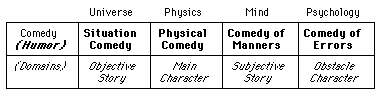
Suppose we wanted to write a Comedy with the Objective Story Domain of Universe and the
Main Character Domain of Physics. We could assign all of the Domains to the grid in the
Comedy mode of expression like above.
If we are good storytellers, all four throughlines would have a consistently humorous
(comedic) feel to them. The Objective Story would be a situation comedy; the Main
Character would be a physically goofy or funny person(e.g. Stanley Ipkiss in The Mask);
the Obstacle Character might be someone who is constantly being mistaken for someone else
or mistaking the Main Character for someone else; the Subjective Story relationship
between the Main and Obstacle Characters would be conflicting over silly or exaggerated
differences of opinion.
Though a story like this covers all of the storyforming bases, its single mode of
expression lacks the emotional depth that comes from variety. This monotone form of
storytelling is fine (and often preferable) for some forms of storytelling. Many
audiences, however, prefer to have greater variety of expression in their stories. As it
stands, this example story lacks any educational intent (Information), any sense of
seriousness (Drama), and any pure diversions (Entertainment).
How does one diversify? Assign each Domain to a different mode of expression.
A story of such a completely mixed arrangement has no single, overriding feel to it. What
it gives up in consistency, however, it gains in variety.
The Objective Story (Universe/Entertainment) would be set in some unique or viscerally
intriguing setting (perhaps a Western, the distant future, or the dark side of the moon)
in which something is amiss. In this setting we find our Main Character (Physics/Comedy),
perhaps clumsy (e.g. Inspector Clouseau from The Pink Panther), or overly active
like Ace Ventura. Providing a nice contrast to the humorous nature of the Main
Character are the serious impact of Obstacle Character's manipulations (Psychology/Drama).
Finally, we add the Subjective Story relationship (Mind/Information) as it describes how
the Main and Obstacle Characters' fixed attitudes conflict over "what it all
means."
This is the heart of Dramatica's approach to Genre. At its most basic level it is a choice
between four modes of expression. At its most exciting and elegant, it concerns the
sophisticated relationship and dynamics that are created when the four modes of
expression, the four structural Classes, and the four Domains are brought together. The
Class/modes of expressions grid allows authors to select Domains using their feelings and
intuition. By carefully setting these Dramatica relationships in a story, you can create a
powerful Genre experience for your audience with exactly the impact you intended.
Finally, there is a greater depth to Dramatica theory that offers more information about
what is really going on in Genre. It may be more than you really need to consider for your
style of writing and the kinds of stories you create. If you'd like to explore this final
aspect of The Elements of Structure, read on.
The Class/modes of expression table we have been using makes it appear as if a throughline
must remain in one mode for the duration of a story. In fact, this is only the Static
Appreciation of Genre. In actual practice, the Genre of a story develops as the story
unfolds, so that it may appear to be simply a Drama as it begins, by the time it is over
it will have defined exactly what kind of Drama it is.
In this respect, beginning as one among a broadly identifiable group of stories and ending
up where no other story has gone before, each and every story develops its own unique
Genre by the time it is over. The manner by which this happens pertains to the Progressive
Appreciation of Genre, which we will now explore.
First of all, once a throughline is assigned to a Class, thereby creating a Domain, that
particular combination will remain for the duration of the story. Therefore, when we
examine how the Mode/Class table is laid out, we can see that each Domain will fall in a
vertical column and stay there. The Progressive nature of Genre is seen when each Domain slides
up and down its particular column so that during the story it may touch on all four modes
of expression. The fact that each Domain is always in its same Class gives them
consistency; the ability to shift modes of expression gives them versatility.
Just as with Progressive Plot appreciations there are limits to how a Domain can
move from one mode to another. Like the Acts in Plot, Domains must move through modes of
expression in a particular order. The rule of thumb is that a Domain cannot skip over
a mode (according to the order used in the table) but must go through each mode of
expression in between to get to the desired one.
The reason for this limitation is that neither the human mind nor the Story Mind can shift
mental gears from, say, first gear to third gear without going through second gear. Modes
of expression are largely emotional concerns, and as such, the human mind must be allowed
to experience the transition from one emotional state to the next if it is to feel
natural.
A good example of the awkwardness that results from ignoring this rule of thumb can be
found in the motion picture, Hudson Hawke, starring Bruce Willis. The filmmakers
made a valiant effort to break convention and have a serious heist thriller jumbled up
with comedy and even song and dance numbers in the middle of a robbery! This might have
worked, had the audience been taken through the intermediate modes. Alas, such was not the
case and therefore the story simply came out jumbled and impossible to get a grip on
emotionally.
It should be noted that sometimes in the process of storytelling an author will want to
shock an audience. This can be accomplished in a number of ways, including breaking
structure or skipping the transitional modes of expression. These kinds of techniques are
fully explored in the Storyweaving section of The Art of Storytelling. For now, our
discussion is limited to what a consistent progression of Genre would be.
If you have closely examined the table, you may have wondered if the mode at the top
(Information) could ever connect to the mode at the bottom (Entertainment) without having
to go through both Drama and Comedy first. The answer to this question is,
"Yes."
If you were to clip the Class/modes of expression table out of this book (not
recommended!) you could bend it around from top to bottom to make a cylinder. When
presented in this form, it can be seen that Information is actually right next to
Entertainment. So, during the course of a story, a single Domain might shift up or down or
all around, as long as it stays within its Class column.
Taken together, all four Domains could shift from scene to scene into different relative
positions, not unlike a combination lock, making the story all comedic at one time,
serio-comic at another, and so on. By the end of the story, the progressive shift of
Domains provides the combination for the unique Genre of a story.
Proceed
to the Next Section of the Book-->
How to Order Dramatica:
A New Theory of Story
Back to
the Table of Contents
Back to the Dramatica Home Page
Copyright 1996, Screenplay Systems, Inc.
The Dramatica theory was developed by
Melanie Anne Phillips and Chris Huntley
Chief Architect of the Dramatica software is Stephen
Greenfield
Dramatica is a registered trademark of Screenplay Systems Incorporated
Visit
the Dramatica Theory Home Page
Try Dramatica & StoryWeaver Risk
Free*

$179.95
$29.95
*Try either or both for 90 days. Not working for you?
Return for a full refund of your purchase price!
About Dramatica and
StoryWeaver
Hi, I'm Melanie Anne Phillips,
creator of StoryWeaver,
co-creator of Dramatica
and owner of Storymind.com. If you have a moment, I'd like to tell you
about these two story development tools - what each is designed to do, how
each works alone on a different part of story development and how they can be
used together to cover the entire process from concept to completion of your
novel or screenplay.
What They Do
Dramatica is a tool to help you
build a perfect story structure. StoryWeaver is a tool to help you build
your story's world. Dramatica focuses on the underlying logic of your
story, making sure there are no holes or inconsistencies. StoryWeaver
focuses on the creative process, boosting your inspiration and guiding it to add
depth, detail and passion to your story.
How They Do It
Dramatica has the world's only
patented interactive Story Engine� which cross-references your answers to
questions about your dramatic intent, then finds any weaknesses in your
structure and even suggests the best ways to strengthen them.
StoryWeaver uses a revolutionary new
creative format as you follow more than 200 Story Cards� step by step through
the story development process. You'll design the people who'll inhabit
your story's world, what happens to them, and what it all means.
How They Work
Together
By itself Dramatic appeals to
structural writers who like to work out all the details of their stories
logically before they write a word. By itself, StoryWeaver appeals to
intuitive writers who like to follow their Muse and develop their stories as
they go.
But, the finished work of a
structural writer can often lack passion, which is where StoryWeaver can help.
And the finished work of an intuitive writer can often lack direction, which is
where Dramatica can help.
So, while each kind of writer will
find one program or the other the most initially appealing, both kinds of
writers can benefit from both programs.
Try Both Programs
Risk Free!
We have a 90
Day Return Policy here at Storymind. Try either or both of these
products and if you aren't completely satisfied we'll cheerfully refund your
purchase price.
Our
Complete Catalog of Products
|

Get
the Writer's Survival Kit Bonus Package
FREE with ANY purchase!
A $300 Value!
|
|
StoryWeaver
- $29.95
Our
Bestseller! A
step by step approach to story development, from concept to completed
story for your novel or screenplay. More than 200 interactive
Story Cards guide you through the entire process.
|
|
Dramatica
Pro - $179.95
Includes
2 Exclusive Bonuses! The
most powerful story structuring software available, Dramatica is driven
by a patented "Story Engine" that cross-references your
dramatic choices to ensure a perfect structure.
|
 |
Dramatica
Writer's DreamKit - $49.95
Little
brother to Dramatica Pro, Writer's DreamKit is built around the same
patented Story Engine - it just tracks fewer story points. So, you
develop the same solid story structure, just with fewer details.
Perfect for beginning writers or those new to Dramatica.
|
 |
Power
Structure - $149.95
An
all-in-one writing environment with built-in word processor that helps
you organize and cross-reference your story development materials.
INCLUDES DVD SET BONUS!
|
|

|
Power
Writer - $99.95
The little
brother of Power Structure includes the essential organization and word
processing tools writers need the most.
|
 |
Throughline
- Index Cards (Mac) - $19.95
Interactive
index cards - add notes, titles, colors, click and drag to re-arrange.
An essential tool for every writer.
|
|
Movie
Magic Screenwriter - $149.95
The most
advanced screenwriting software available, Movie Magic is deemed a
"preferred file format" by the Writer's Guild. An
industry standard, MMS is used by professionals and studios around the
world.
|
|

|
Final
Draft - $199.95
Like Movie
Magic Screenwriter, Final Draft is an industry standard, used by many
professional screenwriters and studios around the world.
|
 |
Between
The Lines (Macintosh) - $29.95
The lowest
cost automatic screenplay formatter for Macintosh includes high-end
features such as interactive index cards linked to your script.
|
|

|
 |
12
Hour Writing Course - $19.95
Everything
you need to know about story structure - twelve hours of video on a
single DVD - presented by Dramatica Theory co-creator, Melanie Anne
Phillips.
|
 |
Dramatica
Software Companion - $19.95
More than
four hours of video demonstrations of every key feature in Dramatica,
narrated by the co-creator of Dramatica.
|
 |
StoryWeaving
Tips Book - $19.95
170 pages of
eye-opening essays on story structure, storytelling, finding inspiration
and a wide variety of writing techniques.
|
|
StoryWeaving
Seminar 8 DVD Set - $99.95
14 hours of
video from a live two day course taught by theory co-creator Melanie
Anne Phillips covering Dramatica story structure and StoryWeaver
storytelling.
|
|
StoryWeaving
Seminar Online - $49.95
The same 14
hour program presented in streaming video that you can view online or
download for a permanent copy.
|
|
Dramatica
Theory 2 Hour Audio Program - $19.95
Every key
concept in the Dramatica Theory of Story is fully explained in this
double-CD set.
|
|

|
Writing
Characters of the Opposite Sex - $29.95
A three-hour
audio CD set that explains everything you need to know to create
characters of both sexes that ring absolutely true (and maybe even gain
insight into the communication problems in the real world!)
|
 |
Master
Storyteller Improves Your Writing - $29.95
Become a
better writing with this series of interactive exercises.
|
|

|
How
to Create Great Characters DVD - $19.95
A 90 minute
video program recorded during Dramatica co-creator Melanie Anne
Phillips' live in-person seminar on story structure and storytelling.
|
|

|
Structure
vs. Passion - Audio CD $19.95
The Story
Mind approach to writing uses your own passions to create your story's
structure. It focuses your efforts, clarifies the direction of
your story, and triggers your imagination.
|
|

|
Writing
with the Story Mind - Audio CD - $19.95
Learn how to
psychoanalyze your story's "mind" to uncover and treat
problems with characters, plot, theme, and genre.
|
|

|
|
|
Academic
Prices - Discounts on Select Products
Are you a
student, teacher, or academic staffer? Get the very best price on
select products with these manufacturer sponsored academic discounts!
|
|

|
Package
Deals - Starting at $49.95
Get deep
discounts with these bundles of our most popular writing products.
|
|

|
Writer's
Survival Kit Bonus Package - FREE!
Free with
ANY purchase - Writing software, online writing workshops, writing
seminars on video, story theory book, and much, MUCH more!
|
| |
|














 Format:
Windows / Mac CD-ROM
Format:
Windows / Mac CD-ROM
