Chapter 6
Action and Decision Elements
of Driver and Passenger Characters
Recap of Archetypal Characters
Now that we have become familiar with Archetypal characters and some of their
limitations, let us recap our list of the eight Archetypal Characters as a prelude to
resolving the inconsistencies we saw in The Wizard of Oz and Jaws:
PROTAGONIST: The traditional Protagonist is the driver of the story: the one who
forces the action. We root for it and hope for its success.
ANTAGONIST: The Antagonist is the character directly opposed to the Protagonist. It
represents the problem that must be solved or overcome for the Protagonist to succeed.
REASON: This character makes its decisions and takes action on the basis of logic,
never letting feelings get in the way of a rational course.
EMOTION: The Emotion character responds with its feelings without thinking, whether
it is angry or kind, with disregard for practicality.
SKEPTIC: Skeptic doubts everything -- courses of action, sincerity, truth --
whatever.
SIDEKICK: The Sidekick is unfailing in its loyalty and support. The Sidekick is
often aligned with the Protagonist though may also be attached to the Antagonist.
GUARDIAN: The Guardian is a teacher or helper who aids the Protagonist in its quest
and offers a moral standard.
CONTAGONIST: The Contagonist hinders and deludes the Protagonist, tempting it to
take the wrong course or approach.
Splitting Archetypes Into
Action and Decision Characteristics
Re-examining the list, we can learn something new that will help us in analyzing The
Wizard of Oz and Jaws: each of the Eight Archetypal Characters contains one
characteristic pertaining to actions and another characteristic pertaining to decisions.
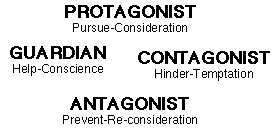
PROTAGONIST
Action Characteristic: Pursues the goal. The traditional Protagonist is the driver
of the story: the one who forces the action.
Decision Characteristic: Urges the other characters to consider the necessity of
achieving the goal.
ANTAGONIST
Action Characteristic: The Antagonist physically tries to prevent or avoid the
successful achievement of the goal by the Protagonist.
Decision Characteristic: The Antagonist urges the other characters to reconsider
the attempt to achieve the goal.
GUARDIAN
Action Characteristic: The Guardian is a helper who aids the efforts to achieve the
story goal.
Decision Characteristic: It represents conscience in the mind, based upon the
Author's view of morality.
CONTAGONIST
Action Characteristic: The Contagonist hinders the efforts to achieve the story
goal.
Decision Characteristic: It represents temptation to take the wrong course or
approach.
REASON
Action Characteristic: This character is very calm or controlled in its actions.
Decision Characteristic: It makes its decisions on the basis of logic, never
letting emotion get in the way of a rational course.
EMOTION
Action Characteristic: The Emotional character is frenzied or uncontrolled in its
actions.
Decision Characteristic: It responds with its feelings with disregard for
practicality.
SIDEKICK
Action Characteristic: The Sidekick supports, playing a kind of cheering section.
Decision Characteristic: It is almost gullible in the extent of its faith -- in the
goal, in the Protagonist, in success, etc.
SKEPTIC
Action Characteristic: The Skeptic opposes -- everything.
Decision Characteristic: It disbelieves everything, doubting courses of action,
sincerity, truth -- whatever.
Split Archetypes in Quads
Having split them in two, we can see that each of the Archetypal Characters has an
attitude or Decision characteristic and an approach or Action characteristic. When we
arrange both characteristics under each of the eight Archetypes in our Driver and
Passenger Quad format, we get a graphic feel for the Archetypal Objective Characters and
the Elements they represent.
Driver Quad
Passenger Quad
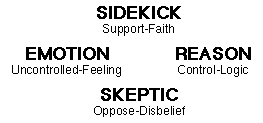
In Dramatica, we refer to these 16 characteristics as the Motivation Elements because
they describe what drives the Archetypal Characters.
The 16 Motivation Elements in Star Wars
Elements of Star Wars Characters
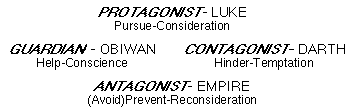
Let's see how well these sixteen Motivation Elements line up with the characters we
have examined so far. As Protagonist, Luke does indeed seem to be both the pursuing
character and the one who urges all to consider the need to achieve the goal
("We've got to help the Princess!"). The Empire definitely wants to prevent
Luke from succeeding, and urges him and all others to reconsider the propriety of
his actions - reconsider or you will die. Obi Wan provides a sense of conscience,
at the same time helping Luke when he gets into trouble. Darth, on the other hand,
clearly represents the tempting "Dark side of the Force," as well as hindering
Luke's progress, the Rebel's progress, and even hindering progress by the Empire itself!
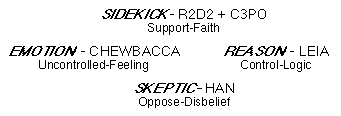
R2D2 and C3PO are ever faithful and supportive, and Han is the perennial disbeliever
and opposer. Chewbacca acts on his feelings and behaves in an uncontrolled
way, and Leia is extremely controlled and driven by logic.
Charted out, the assignment of characteristics to the various characters has a good feel
to it.
Character Quads with Elements
Driver Quad
Passenger Quad
The 16 Motivation Elements in The Wizard of Oz
Archetypal Elements of "Oz" Characters
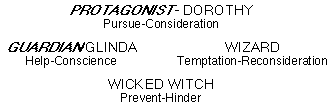
Returning to Oz, Dorothy is both pursue and consideration. Toto is faith
and support. The Cowardly Lion is clearly disbelief and oppose, and
Glinda is conscience and help. But here is where breaking the Eight
Archetypal Characters into 16 characteristics solves our previous problems.
Tin Man and Scarecrow Swap Meet
When we look at the Scarecrow he appears to exemplify logic but his approach,
rather than being in control, is quite uncontrolled. Similarly, although the Tin
Man is undoubtedly feeling, his demeanor is just as surely described by control.
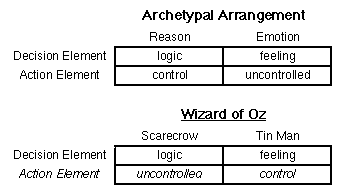
Apparently, the Scarecrow and the Tin Man have swapped characteristics: logic goes with
uncontrolled and feeling goes with control. In a sense, both of these Characters now
contain two Elements that are at odds with each other. The Action Element does not reflect
the Decision Element. This creates two very interesting Characters who have an additional
degree of depth to them: an internal friction, inconsistency, or conflict. This is the
kind of arrangement that begins to make characters more complex.
Witch and Wizard Ways
But what about the Witch and the Wizard? What is it that makes them diverge from the
Archetypal molds? Could it be a similar "swapping" of Elements? As it turns out,
it is a similar swapping, but not exactly the same. To be the Archetypal
Contagonist, the Wizard would have to be temptation and hinder. To be the
Antagonist, the Witch would have to be reconsideration and prevent. But
rather than swapping an Action Element for another Action Element, the Witch ends up with both
Action Elements and the Wizard with both Decision ones!

"Oz" Elements in Quads
When we put this information into our Quad formation, the Elements do not line up in a
simple way.
Driver Quad
Passenger Quad
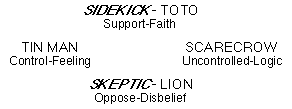
Everyone still has two characteristics; however, the arrangements are not Archetypal
for all the Characters in The Wizard of Oz. As a result, the Archetypal role
names have been removed where they do not apply.
The 16 Motivation Elements in Jaws
Elements of Jaws Characters
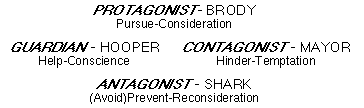
Brody, as Protagonist, is very nicely pursue, and certainly with his
bell-ringing and whistle-blowing Brody is consideration as well. Hooper does
provide the sense of conscience and helps Brody. The Mayor definitely hinders
our Protagonist and dishes out plenty of temptation to give up the quest. Certainly
the shark forces reconsideration of the propriety of the goal and goes out of its
way to prevent Brody from accomplishing his goal of adjusting its feeding habits.
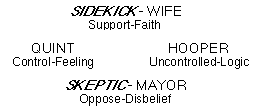
Brody's wife is his faithful supporter. Hooper adds to his functions by
filling the role of logic as well, yet he is very uncontrolled in his
approach, as made evident by the variety of devices he employs to no apparent success.
Quint is clearly operating from his feelings, but his approach is very simple and
in control. The Mayor, in addition, supplies us with disbelief and oppose.
Driver Quad
Passenger Quad
How to Order your copy of
Dramatica: A New Theory of Story
Back to the Table of Contents
Back to Home Page
Copyright 1996, Screenplay Systems, Inc.
The Dramatica theory was developed by Melanie Anne Phillips and Chris Huntley
Chief Architect of the Dramatica software is Stephen
Greenfield
Dramatica is a registered trademark of Screenplay Systems Incorporated















 Format:
Windows / Mac CD-ROM
Format:
Windows / Mac CD-ROM