|
 |
 |
 |
 |
 |
 |
 |
|
|
|
|
(this is the synthesis of a few thought experiments inspired by Jeff Behnke in the list, but the fevered elucubrations are mine. Jeff is not responsible for any distorting done here ;-) ) If the Domains were described as a function of an
"action/decision/point_of_view" "threespace" locator, the T-lines seem
to be domains of variation: each one presents the action-decision range. If we take the
Cartesian model, the X could be action, the Y decision, and the negative/positive could be
the internal/external dichotomy. Then the domains would be variation ranges, like in a
"Rosetta" equation, you know, the four loops or lobes with origin in 0,0 (darned
if I recall the That still leaves space for the subjective/objective thing, linking absolute -Z (the author's innermost) to +Z (the audience's innermost). Communication, then, could happen in a multilobed structure, not too far away from Zero (0,0,0) so there is still common ground, and not too great around that same Zero, so that there is enough divergence to have conflict.
The introduction of Z axis distorts the perfect arrangement of four T-line fields lying
"flat" to the X/Y plane but would produce eight directions, easy to visualize if
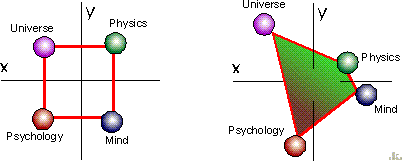
you imagine the "flat" model as a square with a T-line in each corner, and then
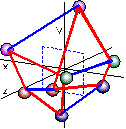
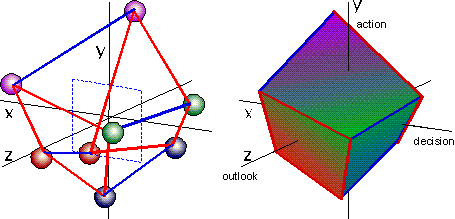
inflate the square to a cube, with 4 "front" t-lines and 4 "rear"
t-lines, that are dependent on the (not shouting) DISTANCE from total, boring,
already-known, 0,0,0, to the moment the function approaches This perception does not seem to be at odds with the analysis made in this list of what the domains amount to. The combinations would be: Internal and External Action (-Y to +Y) & Internal and External Decision (-Z to +Z), from the unique view (-Z) of the writer and from the common view (+Z) of the audience. -X,-Y,-Z Jeff: >Now if we can just figure out the way your drawing can be applied to Ok, let me risk neck and limb:
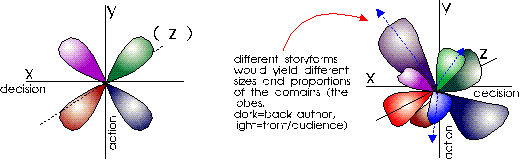
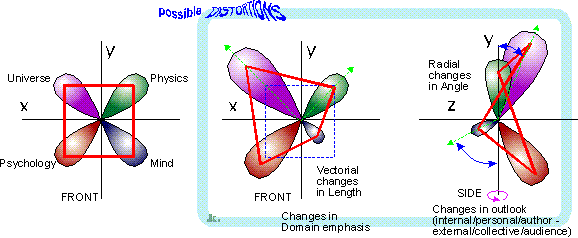
One must keep in mind that the lobes represent probability regions, zones where the interest (and therefore the conflict) are maximized. That means that by changing the equations that control the data ranges of the lobes, different deformations can be achieved. We are in a sense back to one set of lobes, since we can concentrate on the storyform, not the "real" process anymore (this because the complete process involves author-audience spectrum, and now we are considering the "neutral" storyform, which would be a choice of spectrum probabilities). There are two basic kinds of deformations from the "flat" ideal model that can happen to these kind of radially symmetric structures:
The Changes can be in the distance from the Origin (0,0,0) to the maximum probability region would produce different vectors, and in the orientation, or angular rotation of those vectors in 3DSpace. The new facets produced are no longer necessarily defined within coplanar vertices, so deformations or distortions in 3D appear on the basic 2D state model. Let's reduce the lobate structures to just the regions of maximum probability for uncluttered view's sake, and look at the facet defined by the four regions focii, both at "rest" and in a point of its motion.
These distortions continue in the next level: the particular distortions applied from the outlook of the author to the outlook of the audience, would result not in a distorted face of non-necessarily coplanar vertices, but in a distorted volume of information space,
This volume is no longer defined by "flat" square facets of coplanar vertices, but more by lattices of 2 to 4 triangles per face: the edge lines continue to be straight, but the bound areas have their own topologies tangential to the center, not to the other edges. The primordial jello cube. .k. Visit the Dramatica Theory Home Page  $179.95 $29.95 *Try either or both for 90 days. Not working for you? Return for a full refund of your purchase price! About Dramatica and StoryWeaver Hi, I'm Melanie Anne Phillips, creator of StoryWeaver, co-creator of Dramatica and owner of Storymind.com. If you have a moment, I'd like to tell you about these two story development tools - what each is designed to do, how each works alone on a different part of story development and how they can be used together to cover the entire process from concept to completion of your novel or screenplay. What They Do Dramatica is a tool to help you build a perfect story structure. StoryWeaver is a tool to help you build your story's world. Dramatica focuses on the underlying logic of your story, making sure there are no holes or inconsistencies. StoryWeaver focuses on the creative process, boosting your inspiration and guiding it to add depth, detail and passion to your story. How They Do It Dramatica has the world's only patented interactive Story Engine™ which cross-references your answers to questions about your dramatic intent, then finds any weaknesses in your structure and even suggests the best ways to strengthen them. StoryWeaver uses a revolutionary new creative format as you follow more than 200 Story Cards™ step by step through the story development process. You'll design the people who'll inhabit your story's world, what happens to them, and what it all means. How They Work Together By itself Dramatic appeals to structural writers who like to work out all the details of their stories logically before they write a word. By itself, StoryWeaver appeals to intuitive writers who like to follow their Muse and develop their stories as they go. But, the finished work of a structural writer can often lack passion, which is where StoryWeaver can help. And the finished work of an intuitive writer can often lack direction, which is where Dramatica can help. So, while each kind of writer will find one program or the other the most initially appealing, both kinds of writers can benefit from both programs. Try Both Programs Risk Free! We have a 90 Day Return Policy here at Storymind. Try either or both of these products and if you aren't completely satisfied we'll cheerfully refund your purchase price.
Our Complete Catalog of Products
|
| ||||||||||||||||||||||||||||||||||||||||||||||||||||||||||||||
|
Contact Us - About Us - Lowest Price Guarantee - Shipping - Return Policy Copyright Melanie Anne Phillips - Owner, Storymind.com, Creator Storyweaver, Co-creator Dramatica |











 Dramatica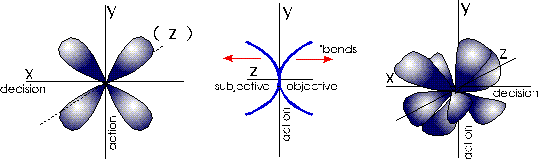
 Format:
Windows / Mac CD-ROM
Format:
Windows / Mac CD-ROM