Groucho Marx once said, “You’re headed for a nervous breakdown. Why don’t you pull yourself to pieces?” That, in fact, is what we’re going to do to our hero.
Now many writers focus on a hero and a villain as the primary characters in their stories. And there’s nothing wrong with that. But as we are about to discover, there are so many more options for creative character construction.
Take the average hero. What qualities might we expect to find in the fellow? In fact, there are four principal attributes.
For one thing, the traditional hero is always the Protagonist. By that we mean he or she is the Prime Mover in the effort to achieve the story goal. This doesn’t presuppose the hero is a willing leader of that effort. For all we know he might accept that charge kicking and screaming. Nonetheless, once stuck in the situation, the hero provides the push to achieve the goal.
Another quality of a stereotypical hero is that he is also the Main Character. By this we mean that the hero is constructed so that the audience stands in his shoes, or at least right behind his shoulder. In other words, the audience identifies with the hero and sees the story as centering around him.
The third quality of the most usual hero configuration is being a “Good Guy.” Simply, he intends to do the right thing. Of course, he might be misguided or inept, but he wants to do good, and he does try.
And finally, let us note that heroes are usually the Central Character, meaning that they get more “media real estate” (pages, screen time, lines of dialog) than any other character.
Listing these four qualities we get:
1. Protagonist.
2. Main Character.
3. Good Guy.
4. Central Character
Getting right to the point, the first two items in the list are structural in nature, while the last two are storytelling. Protagonist describes the character’s function from the Objective View described earlier. Main Character positions the audience in that particular character’s spot through the Main Character View. In contrast, being a Good Guy is a matter of personality, and Central Character is determined by the attention given to that character by the author’s storytelling.
You are probably familiar with the terms Protagonist, Main Character, and Central Character. But you’ve probably also noticed that I’ve used them here in very specific ways. In actual practice, most authors bandy these terms about more or less interchangeably. There’s nothing wrong with that, but for structural purposes it’s not very precise. That’s why you’ll see me being something of a stickler in its use of terms and their definitions: it’s the only way to be clear.
In fact, it is not really important which words you use to describe the four attributes of the hero. What is important is to recognize each of these qualities and to understand what they are.
When developing characters, consider the four “P”s – Psychology, Personality, Persona and Perception.
Psychology is the underlying mentality of the individual.
Personality is the individual’s manner and style.
Persona is the impression the individual wants to create.
Perception is how the individual is seen by others.
All four of these attributes are present in every real person, and must therefore also be present in every fictional character, be it human or otherwise.
To build solid characters, consider our best selling StoryWeaver software, which guides you through the entire story development process step by step from concept to completion. Just $29.95! Learn more…
Working on a new dynamic model of narrative to complement the structural model of Dramatica. Coming up with some interesting thoughts about Timelock and Optionlock as defined in Dramatica and expanded into dynamics.
Here’s some notes:
Timelock in Dramatica is defined as having a narrative come to a climax because it runs out of time – either a deadline or an amount of time, even if spread out non-continously.
Optionlock is defined as running out of options, such as “three wishes” – when the last one is made, it’s over. But it can also be making something large enough or small enough, such as trying to get enough hot air into a balloon to take to the skies before the cannibals arrive.
Deadline – you can retire at 60 and get social security, but each year you wait up until age 70 you will get more per month for the rest of your life. But, if you retire anytime after 70, you won’t get any additional beyond the maximum. What kind of lock is that? Perhaps a combination of timelock and optionlock, or is it best looked at as “optimal time” – or some sort of time constriction rather than a lock?
Timelock vs. Optionlock – Mom: “Time to come in” Child: “Just one more game” or “Just five more minutes.” and did “Time to come in” really mean a specific time, or a time of day such as “getting too dark?”
Early man was almost all optionlock. The seasons are more conditions than specific times. Even looking at a solstice being marked by ancient stones, is it really a time or set of conditions. Timelock requires a regular repeating time that is independent of what is being measured and used as a temporal measuring stick. So, a solstice or equinox is what is being measured and cannot therefore also be the measuring stick. Planting and harvest are not tied to solstice and equinox, but are around them, one way or the other, more analog than discrete.
Sundials provide true timelocks, but hour glasses do not, unless they are truly an hour, calibrated against a sundial, for example. Otherwise, they can be arbitrary in time and are optionlock devices instead, such as “when the sand runs out.”
Timelock thinking is more natural for men who think in discrete terms, than for women who think in more analog terms – one is particle, the other wave, linear logic vs. holistic logic. This, of course, is only dictated by biology at the preconscious level. The other three “levels” of the mind (subconscious, memory, and conscious) are determined to be timelock or optionlock by experience, training, and choice, respectively.
Optionlock thinking is more geared toward child rearing (when child is hungry, when it is sleepy) – Timelock is geared more toward goals, first this, then that or, as would be the case with primitive man, timelocks were of a lower resolution such as before, now, after.
Blue collar work place often timelock (time cards, number of hours, quitting time). White collar often optionlock (salary, when the job is done, when it is good enough).
Inner city culture is more optionlock – poverty leads to optionlock thinking as any one time is as good as another, conditions more important, tune into the rhythms of the city. Sensing danger an opportunity as an ebb and flow, rather than clocking it against an objective measure. Much more like primitive man, in touch with the earth. A complex society becomes so awash in tiny discrete elements that comprise its systems that at the bottom, they cease to be perceived as structures and are connected to as dynamics.
Blue collar work requires timelocks. Those in poverty live and are trained in optionlock. This provides an effective barrier to improving one’s condition is that the non-working class below blue collar cannot perform to timelock expectations, preventing them from taking regular work, leading to the opportunities being day labor, migrant labor, gang membership, or joining the military. The military is an optionlock organization in which one is “on” all the time, and do whatever is asked whenever it is asked.
On the other side of blue collar the white collar folk are all optionlock. They are usually the more intelligent because in school, tests are timed. The smartest never learn the timelock because the usually finish before the time limit, so they are not trained out of optionlock thinking, which is inherent to children and only abandoned when one moves away from the here and now to consider consequences and long-term benefits. Makes corporate leaders more like children, reaping what they can now, and the hell with later.
To reform society must be aware of time/space strata and their connection to social strata.
In this second article in the Dynamic Model series, I’m going to explore really intriguing problem – how particles can be transmuted into waves and vice versa, in terms of narrative.
Why this important to writers and even more important to psychologists and social scientists may not be immediately apparent, so first I’ll outline its potential usefulness and also how it is essential to the expansion of the Dramatica theory into a whole new realm.
Stories might end in success or failure of the effort to achieve the goal. But how big a success, or how great a failure. Now you are talking a matter of degree. What’s more, is it a permanent success/failure or a temporary one? And if temporary, does it always remain at the same level or does it vary, getting bigger, smaller, or oscillating in a symmetrical cyclic or complex manner?
Now, apply this to a character’s motivation. It may be motivated by one particular kind of thing, but is that motivation increasing or decreasing? It is accelerating or decelerating? Is it cyclic or complex, is it transmuting from one nature of motivation to another? And for that matter, how does a character actually change from one nature to another in a leap of faith? Up the magnification and ask, “can I see the exact moment a character’s mind changes from one way of looking at the world to another?”
When is that magic moment at which Scrooge changes? How long does it last? Can we find the spot at which he is one way now and another way a moment later? Is the change a process or an immediate timeless shift from one state to another? What exactly is the mechanism – not the mechanism that leads him to the point of change, but the exact time at which that change occurs?
When can we say that a light switch is off versus being on? Is it how many electrons are crossing the gap, is it the position of the switch at a visual resolution? Is it the light getting brighter? How bright? How fast? How about a mercury light that fades on and off at 60 Hz? When it is on the nadir of the down cycle is it off? And therefore, does the exact moment of a character’s change depend upon momentum? Inertia? Zeno’s paradox?
If writers could follow the rise and fall, the ebb and flow of dramatic potentials, resistances, currents, and powers discreetly for every element, every particle in a story’s structure, one could predict the cognitive and affective impact on the readers or audience as a constantly changing bundle of waveforms, each one thread or throughline in the undulating unbroken progression of experience.
Now project this into psychology, societal concerns, stock market analysis, weather prediction – such a dynamic model would enable incredibly accurate projections as well as far more detailed and complete snap analyses.
BUT
In order for these applications to be realized, we need not only a dynamic model, but also the means of connecting it to the structural model. In other words, we need to develop a particle/wave continuum in which particles can become waves can become particles in an endless flow of cascading shifts and transmutations.
So how does this interface work? What stands between particle and wave that alters one to another?
In the next installment of the Dynamic Model series, I’ll offer some conjectures.
As a reminder, our step by step approach is all about looking at the needs of the author rather than the needs of the story. From this perspective, we can see four stages in the creative process: Inspiration, Development, Exposition, and Storytelling.
Currently, we are at the beginning of the Inspiration stage in which you have previously jotted down all the creative notions you may already have for your story in Step 2.
In Step 3, we described methods for boiling your initial story concepts down into a log line: a single sentence that expresses the essence of what your story is about.
In this step, we’ll use your log line as a creative core in a method that will generate an expanding sphere of new ideas for your story. In following this step, also draw upon the original story ideas you jotted down in Step 2.
The Creativity Two-Step
The concept behind this method of finding inspiration is quite simple, really: It is easier to come up with many ideas than it is to come up with one idea.
Now that may sound counter-intuitive, but consider this… When you are working on a particular story and you run into a specific structural problem, you are looking for a creative inspiration in a very narrow area. But creativity isn’t something you can control like a power tool or channel onto a task. Rather, it is random, and applies itself to whatever it wants.
Yet creative inspiration is always running at full tilt within us, coming up with new ideas, thinking new thoughts – just not the thoughts we are looking for. So if we sit and wait for the Muse to shine its light on the exact structural problem we’re stuck on, it might be days before lightning strikes that very spot.
Fortunately, we can trick Creativity into working on our problem by making it think it is being random. As an example, consider this log line for a story: A Marshall in an Old West border town struggles with a cutthroat gang that is bleeding the town dry.
Step One: Asking Questions
Now if you had the assignment to sit down and turn this into a full-blown, interesting, one-of-a-kind story, you might be a bit stuck for what to do next. So, try this. First ask some questions:
1. How old is the Marshall?
2. How much experience does he have?
3. Is he a good shot?
4. How many men has he killed (if any)
5. How many people are in the gang?
6. Does it have a single leader?
7. Is the gang tight-knit?
8. What are they taking from the town?
9. How long have they been doing this?
You could probably go on and on and easily come up with a hundred questions based on that single log line. It might not seem at first that this will help you expand your story, but look at what’s really happened. You have tricked your Muse into coming up with a detailed list of what needs to be developed! And it didn’t even hurt. In fact, it was actually fun.
Step Two: Answering Questions
But that’s just the first step. Next, take each of these questions and come up with as many different answers as you can think of. Let your Muse run wild through your mind. You’ll probably find you get some ordinary answers and some really outlandish ones, but you’ll absolutely get a load of them!
a) How old is the Marshall?
a. 28
b. 56
c. 86
d. 17
e. 07
f. 35
Some of these potential ages are ridiculous – or are they? Every ordinary story based on such a log line would have the Marshall be 28 or 35. Just another dull story, grinding through the mill.
Step One Revisited
But what if your Marshall was 86 or 7 years old? Let’s switch back to Step One and ask some questions about his age.
For example:
c. 86
1. How would an 86 year old become a Marshall?
2. Can he still see okay?
3. What physical maladies plague him?
4. Is he married?
5. What kind of gun does he use?
6. Does he have the respect of the town?
And on and on…
Return to Step Two
As you might expect, now we switch back to Step Two again and answer each question as many different ways as you can.
Example:
5. What kind of gun does he use?
a) He uses an ancient musket, can barely lift it, but is a crack shot and miraculously hits whatever he aims at.
b) He uses an ancient musket and can’t hit the broad side of a barn. But somehow, his oddball shots ricochet off so many things, he gets the job done anyway, just not as he planned.
c) He uses a Gattling gun attached to his walker.
d) He doesn’t use a gun at all. In 63 years with the Texas Rangers, he never needed one and doesn’t need one now.
e) He uses a sawed off shotgun, but needs his deputy to pull the trigger for him as he aims.
f) He uses a whip.
g) He uses a knife, but can’t throw it past 5 feet anymore.
And on and on again…
Methinks you begin to get the idea. First you ask questions, which trick the Muse into finding fault with your work – an easy thing to do that your Creative Spirit already does on its own – often to your dismay.
Next, you turn the Muse loose to come up with as many answers for each question as you possibly can.
Then, you switch back to question mode and ask as many as you can about each of your answers.
And then you come up with as many answers as possible for those questions.
You can carry this process out for as many generations as you like, but the bulk of story material you develop will grow so quickly, you’ll likely not want to go much further than we went in our example.
Imagine, if you just asked 10 questions about the original log line and responded to each of them with 10 potential answers, you’d have 100 story points to consider.
Then, if you went as far as we just did for each one, you’d ask 10 questions of each answer and end up with 1,000 potential story points. And the final step of 10 answers for each of these would yield 10,000 story points!
Now in the real world, you probably won’t bother answering each question – just those that intrigue you. And, you won’t trouble yourself to ask questions about every answer – just the ones that suggest they have more development to offer and seem to lead in a direction you might like to go with your story.
The key point is that rather than staring at a blank page trying to find that one structural solution that will fill a gap or connect two points, use the Creativity Two-Step to trick your Muse into spewing out the wealth of ideas it naturally wants to provide.
Your goal for this step, then, is to apply the Creativity Two-Step to your original log line and follow your Muse as far as she can take you. More than likely, you’ll end up with something of a mess – a disorganized mash-up of a huge number of story ideas of many different kinds for your novel.
In step 5, we’ll delve into the treasure trove of ideas you’ve generated and begin the process of organizing them into Characters, Plot, Theme, and Genre elements to be further expanded before we move into the Development stage.
This article was based on our StoryWeaver Step-by-Step Story Development Software that guides you through more than 200 interactive Story Cards from concept to completion of your novel or screenplay. Just $29.95 for Windows or Macintosh.
Both Dramatica Pro (Windows) and Dramatica Story Expert (Mac) are geared toward diving right into your story’s structure and making structural choices. But for more intuitive writers this can cause major problems.
While Dramatica Pro has a “Start Here” button on the opening screen and Story Expert has a “New User” section in the opening splash screen options, DON’T GO THERE!!!
Each of these puts you directly onto a path to build your story’s structure by answering a series of questions about your story and your intent as an author and that can scuttle your story development efforts right out of the gate.
This existing approach was intended to show the power and usefulness of the interactive patented Story Engine at the heart of both programs. But an unfortunate side effect is that it also makes Dramatica appear to be incredibly complex and unfamiliar, and also requires an steep learning curve before you get comfortable with the system.
What’s more, when questions are asked such as “What is your Main Character’s Domain?” or “What is the Relationship Throughline’s Catalyst?” it is almost sure to frustrate many authors who are excited by their subject matter and ideas and just want to get started developing and improving their stories.
Fortunately, there is a better place to start: the Story Points Window. The Story Points Window lists all the structural elements in your story with a space to illustrate how that element will appear or come into play in your story. This ensures that there are no structural holes caused by forgetting to include an important point.
Normally the Story Points Window is used after you have already created a structural storyform using the Story Engine, and then can refer to each story point and work out how to implement it in your story. But, again, this puts structure before creativity and flies in the face of the excitement and enthusiasm of getting on with your writing.
So, the tip is to begin with the Story Points Window before making even a single structural choice! Here’s how you do it:
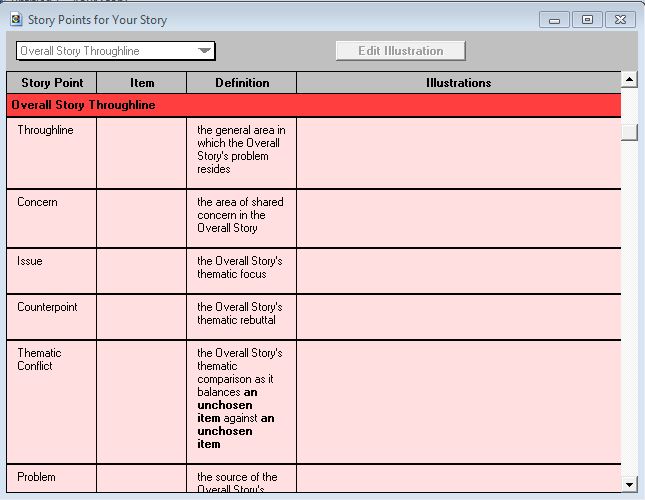
First, open the Story Points Window from the desktop in Dramatica Pro or from the tool bar icon in Dramatica Story Expert. You will find that it contains the names of all the story points tracked by the Story Engine, but doesn’t yet have the structural choice you made listed. (See picture above)
The first column shows the name of each story point. The second column will list your structural choice for that story point when you eventually make it. The third column provides a definition of each story point. The fourth column is where you would normally illustrate how each story point will show up in your story – but we’re going to do it differently….
Start at the top of the list of story points. The first story point is called Resolve. Its definition reads, the ultimate disposition of the Main Character to Change or Remain Steadfast.
If this story point makes sense to you in regard to your story, then in the illustration column, describe how it shows up in your story. If it doesn’t yet connect to your story, skip it and move on to the next.
The difference from the standard way the software says you should go about things is that you don’t have to first make the structural choices directly from all the ideas you have floating around in your head. Rather, first you focus on a story point and describe how it applies to your story’s subject matter, rather than to your structure. Then later you’ll go back and make the structural choices, but when you do, you’ll see what you’ve already written in the Illustration column and the choice will be much easier to make.
As an example of this, you’ll come across a story point called Overall Story Domain which is defined as the general area in which the Overall Story’s problem resides. If you do it Dramatica’s way, you are asked to choose which of four items best describes your Overall Story’s Domain: Situation, Activity, Attitude or Manipulation.
Now that can be a tough choice to make if you haven’t studied exactly what each of these terms means. And trying to get into a mind set where you can sort through all the material you have swirling around in your head about your story to find the answer to that question can sometimes be impossible.
But if you forget about the actual structural choices until later and instead just describe in plain language the general area in which the Overall Story’s problem resides you might write something like, My story’s problem is about traveling to the underworld to recover a talisman that will prevent an alien invasion , then later it will be a lot easier to say, “Well, that is more an Activity than a Situation, Attitude or Manipulation.” Entering the subject matter first makes the structural choice easier later.
So, go through the entire list of Story Points and when you reach the bottom, go through the list one more time and see if you can now write something about the story points you left blank the first time around. Why? Because sometimes the process of organizing your thoughts and getting your ideas out of your head is enough to open new insights.
Once you’ve filled in all the illustrations you can, then go to the Story Guide which is the step by step set of structural questions. You can find it as a button on the Dramatica Pro desktop or in the tool bar icons in Story Expert.
Now, when you go to a structural question, instead of having to face it directly, you’ll find that the illustrations you put in the Story Points window automatically show up on each structural question. So, you can refer to that material and make the structural choice that best describes it. And, of course, you can also revise your illustrations as you go – as you come to know your story better.
Using this method, you’ll never have to run into the wall of structure, but can follow your Muse and then describe what she had told you.
Before the Dramatica software was released – before the theory was completed, we ran into a road block. We had completed the 3-D version of the model and were trying to plot the progression of various stories in each quad to see if we could find patterns of sequence that could predict how a story should unfold.
Though we could see circular patterns in some quads, Z patterns in others, and hairpin patterns in others, they varied from quad to quad and story to story, not only in placement but in the direction in which events progressed along the patterns through each quad.
In short, we were going nuts trying to understand something that felt like it made sense but appeared to be completely chaotic. This was a very depressing time – to get so far and be stuck for so long. And then, one weekend, I took my daughter to the Museum of Science and Industry at Exposition Park in Los Angeles.
There was an exhibit of hands-on science experiments for children. One of these was a row of 21 bar magnets on spindles. You would turn one magnet and the one next to it would turn in response, and so on, until eventually you could get all 21 turning in sync at once.
While we were using this, it struck me – the patterns in the model weren’t to be understood by plotting them on the chart. Rather, all patterns were really just circular around the quad, but the pressures that built tension in a story flipped and rotated the items in a quad, and that each quad affected the ones around it like the row of magnets did.
Armed with this epiphany, I returned to the model and began to write the algorithms the ultimately came to drive the story engine.
StoryWeaver has over 200 interactive story cards that lead you step by step from concept to completed story, but you can also create your own folders and cards.
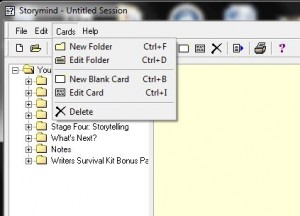
Just go to the Cards menu and select New Folder or New Card. You can even reference work you’ve done on other cards to appear on your new card!
This is useful for organizing your story ideas and research materials. To get you started, there is already a Notes folder (see picture just below the menu in the main list) so you have a convenient place to store your information.
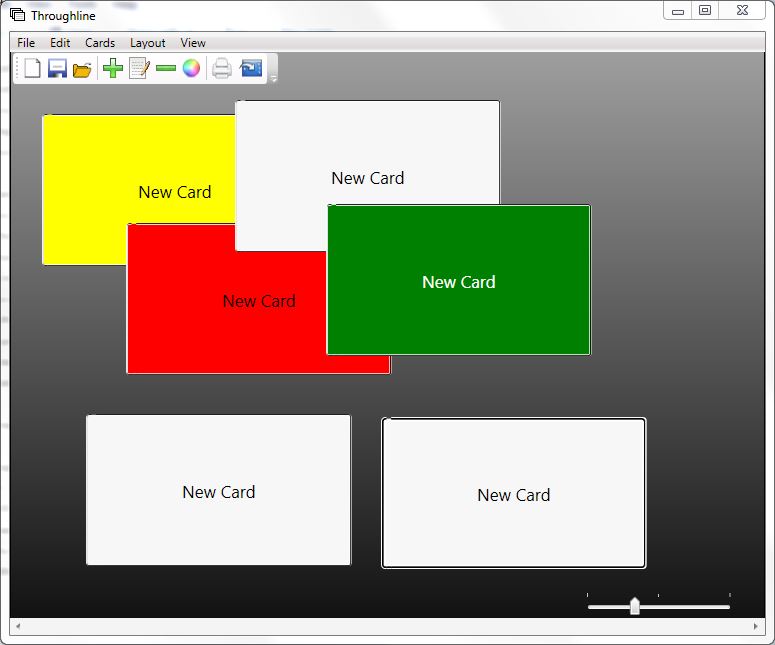
Throughline Interactive Index Cards has five different layout views that help you organize your cards. The default view is called Freestyle and works just like a cork board.
In the Freestyle Layout you can drag your cards anywhere on the screen, stack them up or even create several stacks. This is useful in sorting cards into categories and/or separating the wheat from the chaff.
When we published the first edition of Dramatica: A New Theory of Story, we were concerned that the “Truth” contained in the book would spawn a mob of groupies who would turn it into a cult.
To prevent this, we put the following admonition on a page of its own before the main body of the book:
“This ain’t no bible; it’s just a damn book.”
Although the book did indeed spawn groupies, we discovered they were wise enough to see Dramatica as a tool or a philosophy and not a religion. So we dropped the warning from future editions as it was apparently unnecessary.





You must be logged in to post a comment.