|
|
Software |
StoryWeaver
$29.95

A step by
step approach to story development, from concept to completed story for
your novel or screenplay. More than 200 interactive Story Cards guide
you through the entire process.
Details
and Demo
Dramatica
$149.95

The most
powerful story structuring software available, Dramatica is driven by a
patented "Story Engine" that cross-references your dramatic
choices to ensure a perfect structure.
Details
and Demo
Movie
Magic Screenwriter
$149.95

The most
advanced screenwriting software available, Movie Magic is deemed a
"preferred file format" by the Writer's Guild. An industry
standard, MMS is used by professionals and studios around the world.
Details
and Demo
Throughline
Index Cards
$9.95
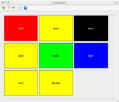
Interactive
index cards - Name them, add notes, titles, colors, click and drag to
re-arrange, adjust font, save, export and print. An essential tool for
every writer.
Details
Academic
Discounts
on Select Products

Are you a
student, teacher, or academic staffer? Get the very best price on select
products with these manufacturer sponsored academic discounts!
Details

|
| |
Dramatica Weekend Workshop
Syllabus
4 THEME
What is Theme*
• Theme deals with perspectives. Authors
create perspectives in their stories, then compare and contrast them to determine which
are better and which are worse according to the author.
• Perspectives are created in the relationship between what you’re looking at
and where you are looking from. A story’s perspectives come from looking at
the story’s problem from each of its four points of view or throughlines.
• Comparing how the story’s problem appears from all four throughlines
creates the story’s meaning.
Creating Perspective
• First step: Create a chart describing
the aspects of a problem that might be considered.
• Second step: Attach the story’s perspectives to the chart.
Classifying Problems
Is the problem External or Internal*
• External States and Processes (Universe and Physics)
* Video Clip: Example of External Problem story: Alien.
• Internal States and Processes (Mind and Psychology)
* Video Clip: Example of Internal Problem story: A Christmas Carol.
The Four Classes:
Universe -- a fixed situation
* Video Clip: Example of External/State (Universe) story: Die Hard.
Physics -- an activity
* Video Clip: Example of External/Process (Physics) story: African Queen.
Mind -- a fixed state of mind
* Video Clip: Example of Internal/State (Mind) story: The Grinch Who Stole
Christmas.
Psychology -- a manner of thinking
* Video Clip: Example of Internal/Process (Psychology) story: Hamlet.
The Dramatica ® Structural Model
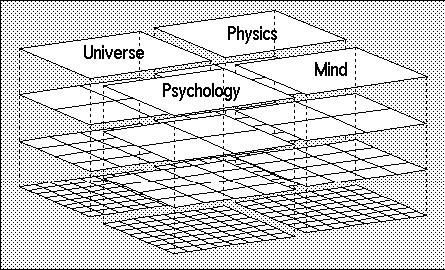 |
Classes
Types
Variations
Elements |
The Dramatica Structural Matrix is a framework for classifying the problem at the
center of a story as it pertains to Genre, Plot, Theme, and Character. During the process
of storyforming, an author determines how the story’s problem will look from four
different points of view: the Objective view, the Main Character view, the Obstacle
character view, and the Subjective view. As points of view are matched to aspects of the
story’s problem they create dramatic topics, called appreciations. The four levels,
starting at the top, are the Class Level, the Type Level, the Variation Level, and the
Element Level.
What happens when we assign points of view to
the Classes*
• Domain: The general area in which the
problem resides.
* Video Clip: Objective Story Situation (Universe) story: The Poseidon
Adventure.
* Video Clip: Main Character Situation (Universe) story: The Elephant
Man.
* Video Clip: Obstacle Character Situation (Universe) story: A
Christmas Carol.
* Video Clip: Subjective Story Situation (Universe) story: The Defiant
Ones.
• Concern: The specific area of concern.
* Video Clip: Objective Story Concern (The Future) story: The Verdict.
* Video Clip: Main Character Concern (Understanding) story: Chinatown.
* Video Clip: Obstacle Character Concern (Becoming) story: The Verdict.
* Video Clip: Subjective Story Concern (Being) story: Bullets Over
Broadway.
• Range: The area most related to the thematic issues explored.
* Video Clip: Objective Story Range (Self Interest) story: Network.
* Video Clip: Main Character Range (Truth) story: Mr. Smith Goes To
Washington.
* Video Clip: Obstacle Character Range (Thought) story: The Silence of
the Lambs.
* Video Clip: Subjective Story Range (Confidence) story: The Silence
of the Lambs.
• Problem: The source of the troubles, inequities, and imbalances.
The Story Problem manifests itself differently for each throughline
* Video Clip: Objective Story Problem (Control) story: Jurassic Park.
* Video Clip: Steadfast Main Character Problem (Unending) story: The
Silence of the Lambs.
* Video Clip: Change Main Character Problem (Test) story: Star Wars.
* Video Clip: Obstacle Character Problem (Desire) story: Chinatown.
* Video Clip: Subjective Story Problem (Avoidance) story: The Verdict.
Main Character Drive: is sometimes a problem and sometimes a solution to the
problem.
Thematic Premise
• “Traditional” thematic premise: e.g. Greed leads to Self-destruction
The traditional premise has three basic parts, the thematic point,
the thematic progression, and the thematic conclusion. In other words, what
you start with, how it leads somewhere else, and what it leads to. The first part, the
thematic point, describes the subject of the premise, the concept upon which the premise
is focused. In our example, the thematic point is greed. Next comes the thematic
progression. The thematic progression describes the activity that the thematic point
promotes. That's the part of our example that says “leads to.” The final part is
the thematic conclusion which describes the result of that activity. Self-destruction is
the result that greed leads to. This is about as much depth as most concepts of theme go
into.
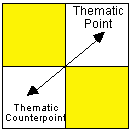
• Thematic Conflict:
In Dramatica, for every thematic point there is a thematic counterpoint that
shows the alternative way things could work out. They both need to be there to show both
sides of a thematic conflict. To prove your thematic point, it's important to show
an alternative considered by other characters in the Story Mind. For example in
“Greed leads to self-destruction,” greed (Self Interest) is just half of the
thematic conflict in that premise. The thematic counterpoint to greed is generosity
(Morality). Generosity illustrates an alternative path that might be pursued.
• Thematic Argument
We have to convince our audience that once you have greed there is no path you can
take to avoid self-destruction. This is the realm of the thematic argument.
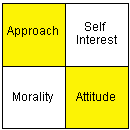 
To work out a thematic argument using the Dramatica theory, take a look at the map
of the Dramatica structure. You'll see a category of items called Variations. You'll
notice they are grouped in families of four, like Morality, Self-Interest, Attitude, and
Approach. To make an argument, every item in a family needs to be played against each
other to see which is better and which is worse. This creates six mini-arguments (or thematic
sequences) that advance the premise toward its conclusion.
• Thematic Conclusion
The traditional premise blends two concepts together that should be determined
independently in Dramatica. These are the story Outcome (success/failure) and the
story Judgment (good/bad). With two choices in Outcome, and two choices in
Judgment, we can see there are four possible combinations that can be used to describe the
flavor of your story's conclusion: triumph (success/good), tragedy (failure/bad), personal
triumph (failure/good), and personal tragedy (success/bad).
Back to the Dramatica Weekend Workshop
Table of Contents
[dramatica/dramatica_footer.htm] | |
|