Home Store About Us Price Beating Shipping Info Return Policy Contact Us


Storymind.com Writing Tips & Writing Software
 

Screenwriting Software

Novel Writing Software - Story Development Software

Books and Videos on Writing

Writing with the Story Mind<br>1 hour audio program
Dramatica &
Accessories


Writing Tools

 
Novel Writing
Screenwriting
Learn the Craft


Our Bestseller!

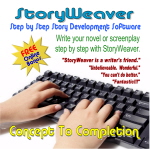
StoryWeaver

Write Your Novel
or Screenplay
Step by Step


$29.95


12 Hour
Writing Course

  
Learn Story Structure
 
PE03328A.gif (2743 bytes)
  
$19.95


Writer's DreamKit

Essential Structure
 
Dramatica Writers DreamKit 4.0
  
$49.95


Dramatica
 
Perfect Structure
 
Dramatica Pro 4.0<br>Plus FREE Bonus!
  
$179.95


Top Articles
 
Be a Storyweaver
NOT a Story Mechanic!
 
How to Create
Great Characters!


A Novelist's
Bag of Tricks

A Screenwriter's
Bag of Tricks

Character Arc 101

Heroes and Villains

Avoiding the
Genre Trap

Creating Characters from Plot

Browse All Articles


Top Classes
 
Progressive Plot Points
 
Audience "Reach"

A Story is an Argument

Dramatica Theory

The Story Mind

Time Locks and
Option Locks

The Four Throughlines Part One

The Four Throughlines Part Two

Browse All Classes


Top Downloads

StoryWeaver Demo
 
Dramatica Demo

Movie Magic Demo

Power Structure Demo

Dramatica
Theory Book

Dramatica
Comic Book

Dramatica
Structure Chart

Browse All Downloads
 

Subscribe to Storymind Writing Tips Newsletter

Dramatica Unplugged

By Melanie Anne Phillips
Creator StoryWeaver, Co-creator Dramatica


Chapter 1 - The Story Mind

1.2  A Tale is a Statement

Imagine the very first storyteller, perhaps a caveman sitting around a campfire. The first communication was not a full-blown story as we know them today. Rather, this caveman may have rubbed his stomach, pointed at his mouth and made a “hungry” sound.

More than likely he was able to communicate. Why? Because his “audience” would see his motions, hear his sounds, and think (conceptually), “If I did that, what would I mean?”

We all have roughly the same physical make-up, we make the assumption that we also think similarly. Therefore when that early man encoded his feelings into sound and motion, the others in his group could decode his symbolism and arrive back at his meaning.

Buoyed by his success in communication, our caveman expands his technique, moving beyond simple expressions of his immediate state to describe a linear series of experiences. For example, he might relate how to get to a place where there are berries or how to avoid a place where there are bears. He would use sign language to outline his journey and to depict the things and events he encountered along the way.

When our storyteller is able to string together a series of events and experiences he has created a tale. And that, simply put, is the definition of a tale: an unbroken linear progression.

We call this kind of tale a “head-line” because it focuses on a chain of logical connections. But you can also have a “heart-line” – an unbroken progression of feelings. For example, our caveman storyteller might have related a series of emotions he had experienced independently of any logistic path.

Tales can be just a head-line or a heart-line, or can be more complex by combining both. In such a case, the tale begins with a particular situation in which the storyteller relates his feelings at the time. Then, he proceeded to the next step which made him feel differently, and so on until he arrives at a final destination and a concluding emotional state.

In a more complex form, emotions and logic drive each other, fully intertwining both the head-line and hear-line. So, starting from a particular place in a particular mood, driven by that mood, the storyteller acted to arrive at a second point, which then made him feel differently.

The tale might be driven by logic with feelings passively responded to each step, or it might be driven completely by feelings in which each logic progression is a result of one’s mood.

And, in the most complex form of all, logic and feelings take turns in driving the other, so that feelings may cause the journey to start, then a logical event causes a feeling to change and also the next step to occur. Then, feelings change again and alter the course of the journey to a completely illogical step.

In this way, our storyteller can “break” logic with a bridge of feeling, or violate a natural progression of feelings with a logical event that alters the mood. Very powerful techniques wrapped up in a very simple form of communication!

We know that the human heart cannot just jump from one emotion to another without going through essential emotional states in between. However, if you start with any given emotion, you might be able to jump to any one of a number of emotions next, and from any of those jump to others. But you can’t jump to all of them. If you could, then we all just be bobbing about from one feeling to another. There would be no growth and no emotional development.

As an analogy, look at Freud’s psycho-sexual stages of development or consider the seven stages of grief. You have to go through them in a particular order. You can’t skip over any. If you do, there’s an emotional mis-step. It has an untrue feeling to the heart.

A story that has a character that skips an emotional step or jumps to a step he couldn’t really get to from his previous mood it will feel wanky to the audience. It will feel as if the character started developing in a manner the audience or readers can follow with their own hearts. It will pop your audience or readers right out of the story and cause them to see the character as someone with home they simply can’t identify.

So the idea is to create a linearity. But doesn’t that linearity create a formula? Well it would if you could only go from a given emotion to just one particular emotion next. But, from any given emotion there are several you might jump to – not all, but several. And from whichever one you select as storyteller, there are several more you might go to next.

Similarly with logic, from any given situation there might be any one of a number of things that would make sense if they happened next. But you couldn’t have anything happen next because some things would simply be impossible to occur if the initial situation had happened first.

Now you can start from any place and eventually get to anywhere else, but you have to go through the in-betweens. So as long as you have a head-line and/or a heart-line and it is an unbroken chain that doesn’t skip any steps, that constitutes a complete tale.


Our Most Popular Products

StoryWeaver Story Development Software - $29.95

Our Bestseller!  By far, our most popular product, outselling all of our other products combined!  StoryWeaver takes you step by step through the entire process--from initial inspiration to completed novel or screenplay.  At just $29.95, StoryWeaver is affordable for any writer.  (Details)

Movie Magic Screenwriter<br>Plus FREE Bonus!

Movie Magic Screenwriter - $149.95

is one of two industry standard word processing screenplay formatters, the other being Final Draft.  Each of these programs offers a complete suite of screenwriting tools to make your next script a breeze to write.  (Details

Dramatica Pro 4.0<br>Plus FREE Bonus!

Dramatica Pro - $179.95

Unlike any other story development product, Dramatica Pro uses a patented Story Engine to interactively help you build a structure, find and fix dramatic holes and inconsistencies.  (Details)

Dramatica Writers DreamKit 4.0

Dramatica Writer's DreamKit - $49.95

Little brother to Dramatica Pro, Writer's DreamKit is built around the same patented Story Engine - it just tracks fewer story points.  So, you develop the same solid story structure, just with fewer details.  Perfect for beginning writers or those new to Dramatica. (Details)

20 hour Writing<br>Course on CD ROM<br>featuring Dramatica

12 Hour Writing Course on DVD - $19.95

This intense program features 12 hours of video documenting the entire college-level course in creative writing given by Melanie Anne Phillips, creator of StoryWeaver and co-creator of Dramatica.  Just $19.95  (Details)


$179.95                       $29.95          

*Try either or both for 90 days.  Not working for you?  Return for a full refund of your purchase price!

About Dramatica and StoryWeaver

Hi, I'm Melanie Anne Phillips, creator of StoryWeaver, co-creator of Dramatica and owner of Storymind.com.  If you have a moment, I'd like to tell you about  these two story development tools - what each is designed to do, how each works alone on a different part of story development and how they can be used together to cover the entire process from concept to completion of your novel or screenplay.

What They Do

Dramatica is a tool to help you build a perfect story structure.  StoryWeaver is a tool to help you build your story's world.

Dramatica focuses on the underlying logic of your story, making sure there are no holes or inconsistencies. 

StoryWeaver focuses on the creative process, boosting your inspiration and guiding it to add depth, detail and passion  to your story.

How They Do It

Dramatica has the world's only patented interactive Story Engine™ which cross-references your answers to questions about your dramatic intent, then finds any weaknesses in your structure and even suggests the best ways to strengthen them.

StoryWeaver uses a revolutionary new creative format as you follow more than 200 Story Cards™ step by step through the story development process.  You'll design the people who'll inhabit your story's world, what happens to them, and what it all means.

How They Work Alone

By itself Dramatic appeals to structural writers who like to work out all the details of their stories logically before they write a word.

By itself, StoryWeaver appeals to intuitive writers who like to follow their Muse and develop their stories as they go.

How They Work Together

But, the finished work of a structural writer can often lack passion, which is where StoryWeaver can help.  And the finished work of an intuitive writer can often lack direction, which is where Dramatica can help.

So, while each kind of writer will find one program or the other the most initially appealing, both kinds of writers can benefit from both programs.

Try Either Program Risk Free!

We have a 90 Day Return Policy here at Storymind.  Try either or both of these products and if you aren't completely satisfied we'll cheerfully refund your purchase price.

 
StoryWeaver Demo
 
Dramatica Demo
 

$29.95padFormat: Windows / Mac CD-ROM
 

  $29.95padFormat: Windows Download
 

$29.95padFormat: Mac OSX Download
 

Download ~ $179.95 

Boxed version ~ $199.95


Student or Teacher?
Get Dramatica Pro for just $99.95!


Writing Tips

 
Articles
Classes
Downloads
 

Top Articles
 
Be a Storyweaver
NOT a Story Mechanic!
 
How to Create
Great Characters!


A Novelist's
Bag of Tricks

A Screenwriter's
Bag of Tricks

Character Arc 101

Heroes and Villains

Avoiding the
Genre Trap

Creating Characters from Plot

Browse All Articles


Top Classes
 
Progressive Plot Points
 
Audience "Reach"

A Story is an Argument

Dramatica Theory

The Story Mind

Time Locks and
Option Locks

The Four Throughlines Part One

The Four Throughlines Part Two

Browse All Classes


Top Downloads

StoryWeaver Demo
 
Dramatica Demo

Movie Magic Demo

Power Structure Demo

Dramatica
Theory Book

Dramatica
Comic Book

Dramatica
Structure Chart

Browse All Downloads


Our Bestseller!

StoryWeaver

Write Your Novel
or Screenplay
Step by Step


$29.95


12 Hour
Writing Course

  
Learn Story Structure
 
PE03328A.gif (2743 bytes)
  
$19.95


Writer's DreamKit

Essential Structure
 
Dramatica Writers DreamKit 4.0
  
$49.95


Dramatica
 
Perfect Structure
 
Dramatica Pro 4.0<br>Plus FREE Bonus!
  
$179.95


Subscribe to Storymind Writing Tips Newsletter

Contact Us - About Us - Lowest Price Guarantee - Shipping - Return Policy - Bonus Package

Copyright Melanie Anne Phillips - Owner, Storymind.com, Creator Storyweaver, Co-creator Dramatica